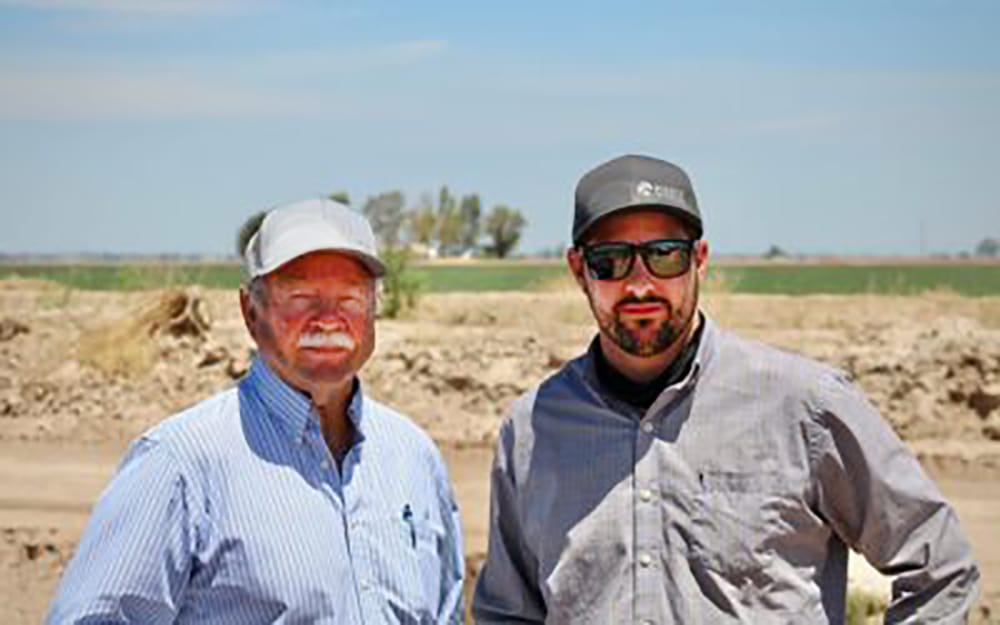
John Hawk, left, and his son Daniel stand in one of their fields on June 20, 2023. Hawk says Imperial Valley farmers will need to be compensated for any water reductions, and that cutbacks should follow the longstanding legal system of prior appropriation. “Don’t crowd to the front of the line,” he says. “It doesn’t work, and you’ll get a fight out of me.” Photo by Alex Hager//KUNC)
Alex Hager
KUNC
Under the broiling hot sun of California’s Imperial Valley, a canal cuts the land in two. On one side, gravelly beige sand is dotted with scrub and shimmering waves of heat blur the mountains in the distance. On the other, sprawling fields of crops blanket the valley floor in a mat of bright green squares.
Here, plentiful sun and high temperatures create a near year-round growing season. Farms sit atop the silty soils of an ancient river delta. And for at least the last hundred years, a steady supply of fresh water from the Colorado River has turned the valley from a baking desert into an agricultural oasis.
“It really is an emerald gem that we have,” said John Hawk, whose family has been growing crops in the Imperial Valley since the early 1900s. “With the water, we can do miracles.”
Hawk and other farmers are reluctant to further cut back on the amount of water they use to keep their fields green, despite pressure from policymakers looking to reduce strain on the Colorado River. Growers say they want to be part of a solution, but are asking for money to incentivize water cutbacks, and hint at other cultural and legal hurdles that stand in the way of reducing their water use.
The Imperial Valley produces $2.9 billion in crops and livestock each year. That’s because the valley’s Imperial Irrigation District holds the largest single allocation of Colorado River water – bigger than any other farming district or city between Wyoming and Mexico. But now, that water allocation is under increasing scrutiny from water managers looking to cut back on water use and correct a perilous gap between supply and demand on the Colorado River.