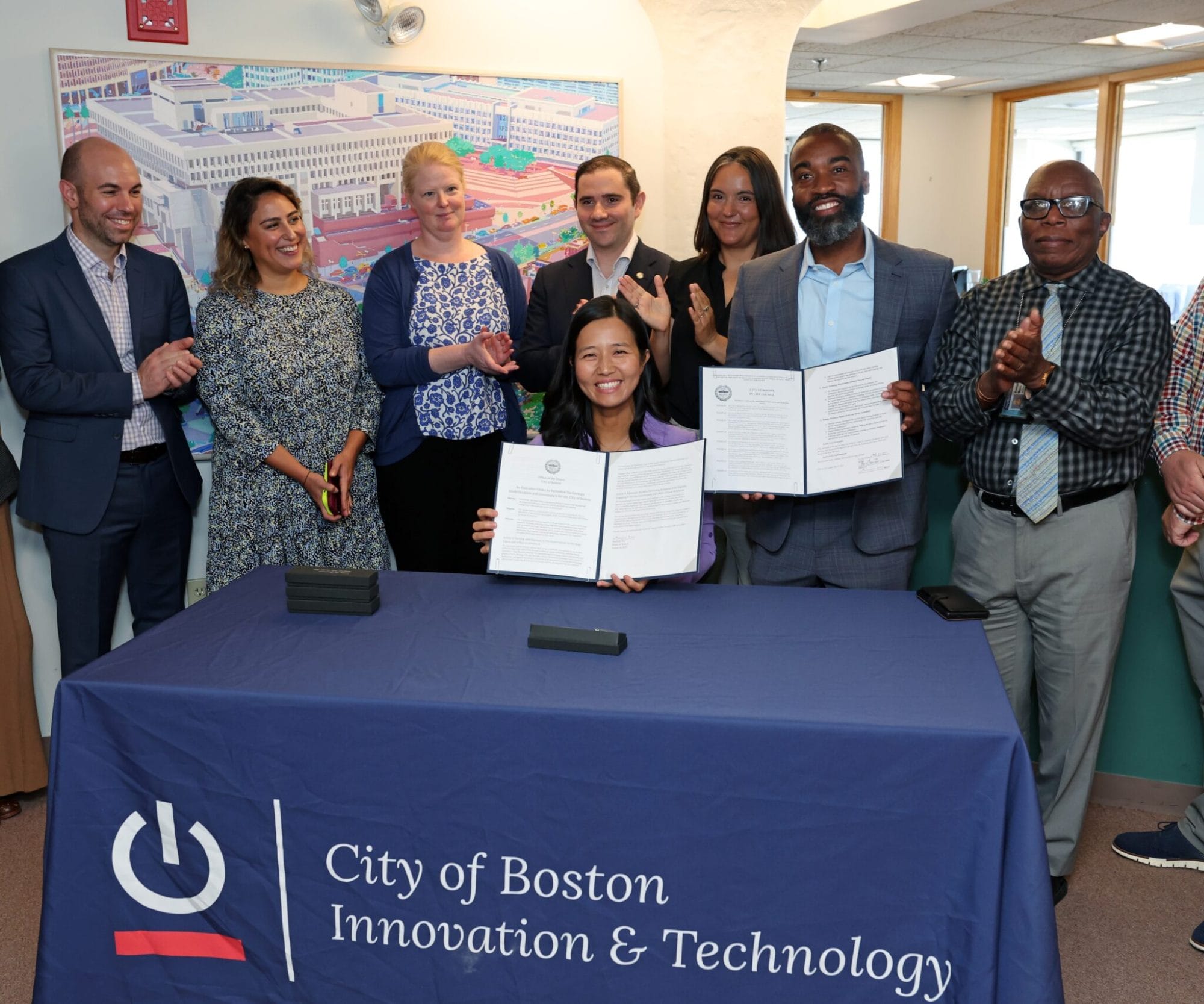
Mayor Michelle Wu signs the Technology Modernization Executive Order on Aug. 18 to accelerate improvements to the City of Boston’s tech infrastructure and digital processes, making it easier to harness innovation and keep projects moving forward. (Photo courtesy of the Boston Department of Innovation & Technology)
By Paige Gross | AZ Mirror
While some states and the federal government take their time in considering how artificial intelligence can and should be used, municipalities across the U.S. have been forging their own way in making AI policies for their government employees.
“AI is generally useful,” Boston’s Chief Innovation Officer Santiago Garces said. “But it is a set of technologies that also carries unique risks that need to be considered. And I think that our employees are generally concerned about accuracy, privacy, security and intellectual property.”
Boston was among the first cities in the U.S. to make a set of guidelines for its employees, rolling out a document outlining the purpose of generative AI in government work, sample use cases, and a set of principles in May 2023.
Garces and his team watched the rollout and quick growth of ChatGPT in 2022, and believed that AI tools were going to have widespread adoption within most industries very quickly. Use of AI felt inevitable in most of the tedious or repetitive tasks of government employees, and Garces said they wanted to work with their employees to figure out the ethical use of AI, instead of resisting it.
“The notion behind the guidelines was enabling this city to be able to get into this period of responsible experimentation, so that we could learn,” Garces said. “Instead of just waiting to see what happened, we would look at managing the risk in a way that was proactive, and engage with all of our workforce as partners in learning.”