Photo via youtube.com
By Keith Walther | Rose Law Reporter
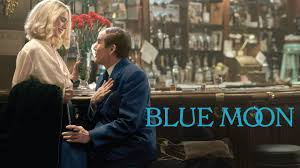
A career best performance from Ethan Hawke could have him dancing with Oscar in March. “Blue Moon” is the riveting true story of lyricist Lorenz Hart that takes place on the night of Broadway’s debut of “Oklahoma!”. This is an old school style of film reminiscent of 1940’s classics that is purely dialogue driven.
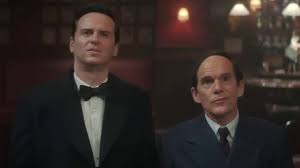
It is March 31, 1943, in New York City. After seeing his career derailed by alcoholism and mental health struggles, the affable Lorenz Hart (Ethan Hawke) must endure the after party celebrating his former longtime partner Richard Rodgers (Andrew Scott) after the famously successful Broadway debut of “Oklahoma!,” which Rodgers helped create with his new partner Oscar Hammerstein II (Simon Delaney). The sexually ambiguous Hart regals patrons of the restaurant bar with his verbose stories to hide his jealousy and bitterness, continually revisiting his obsession with Elizabeth Weiland (Margaret Qualley), his 20-year-old protégé from Yale. As the night fades, it becomes clear that Hart’s stardom is also fading with only the bar staff seeming to pay him any mind, marking the end of one era and the beginning of a new era.
Five-time Oscar nominee Richard Linklater (“Boyhood”) directs this biographical dramedy, returning to his trademark style of setting the film during a single day, and in this case, a single night. He also sets almost the entirety of the film in this New York City restaurant, which drastically increases the degree of difficulty to hold viewers’ attention. With an outstanding screenplay from high school English teacher Robert Kaplow, Linklater masterfully avoids slow pacing issues that would typically plague a production like this. Instead, he weaponizes the quick-witted dialogue, carving up scenes of humorous banter that intellectually stimulate.
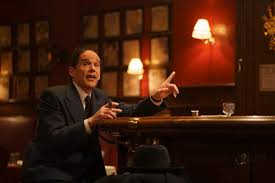
While Linklater fictionalizes the story, he does pull from actual correspondence between Hart and Weiland to depict the characters themselves as accurately as possible. The set design of the restaurant, the soft-focus cinematography technique, the costumes, and the hair and makeup also contribute to the authenticity of that time. However, the scene in which Hart recounts a story of a mouse to famed American writer E.B. White to inspire White to create “Stuart Little” is a complete fabrication. White came up with that story on his own via his own personal dreams.
The other tricky element Linklater had to deal with was Ethan Hawke’s height. Hawke is roughly 5’10” while Lorenz Hart was reportedly below 5’ tall. He successfully shortens his lead actor using creative costuming tricks and oversized sets. Cinematography plays an important role in this as well with various camera angles that look down on the main character.
It is Ethan Hawke’s performance that makes this film dazzle. The sheer amount of dialogue he spews is remarkable, but it is the way he conveys his lines that truly mesmerize. His impassioned and eccentric delivery makes the audience hang on every word. It is also the subtlety of Hawke’s performance that is truly gripping, suppressing this lonely sadness behind the overwhelmingly extroverted surface persona. This establishes a sympathetic tone for his character that slowly deepens as the night wears on and his lack of impact with the Broadway elite becomes more and more evident. The four-time Oscar nominee could very well be in line for his fifth nomination, but his first as a leading actor.
Even though Hawke dominates the screentime and dialogue, there are also some bright spots among the supporting cast. Bobby Cannavale, who plays the bartender, adds some timely comedic quips while also showing genuine care for the main character. The usually overbearing actor seems to find his groove in this understated supporting role. Jonah Lees plays Morty Rifkin, aka Knuckles, who is a GI on leave moonlighting as the restaurant’s piano player. He provides some poignant moments of his own, particularly the bathroom scene in which he patiently and politely listens to the main character for as long as he can, only to eventually leave him midsentence to be alone with his thoughts.
On the surface, this seems like a shallow movie about a drunk egotistically rambling about himself, but this well-written screenplay delves much deeper into the character’s psyche at that singular point in time. If you love dialogue driven films, or richly developed characters, or if you simply love the history of Broadway, then “Blue Moon” is a must see. It’s worth it for Ethan Hawke’s dynamic performance alone.
This movie earns: