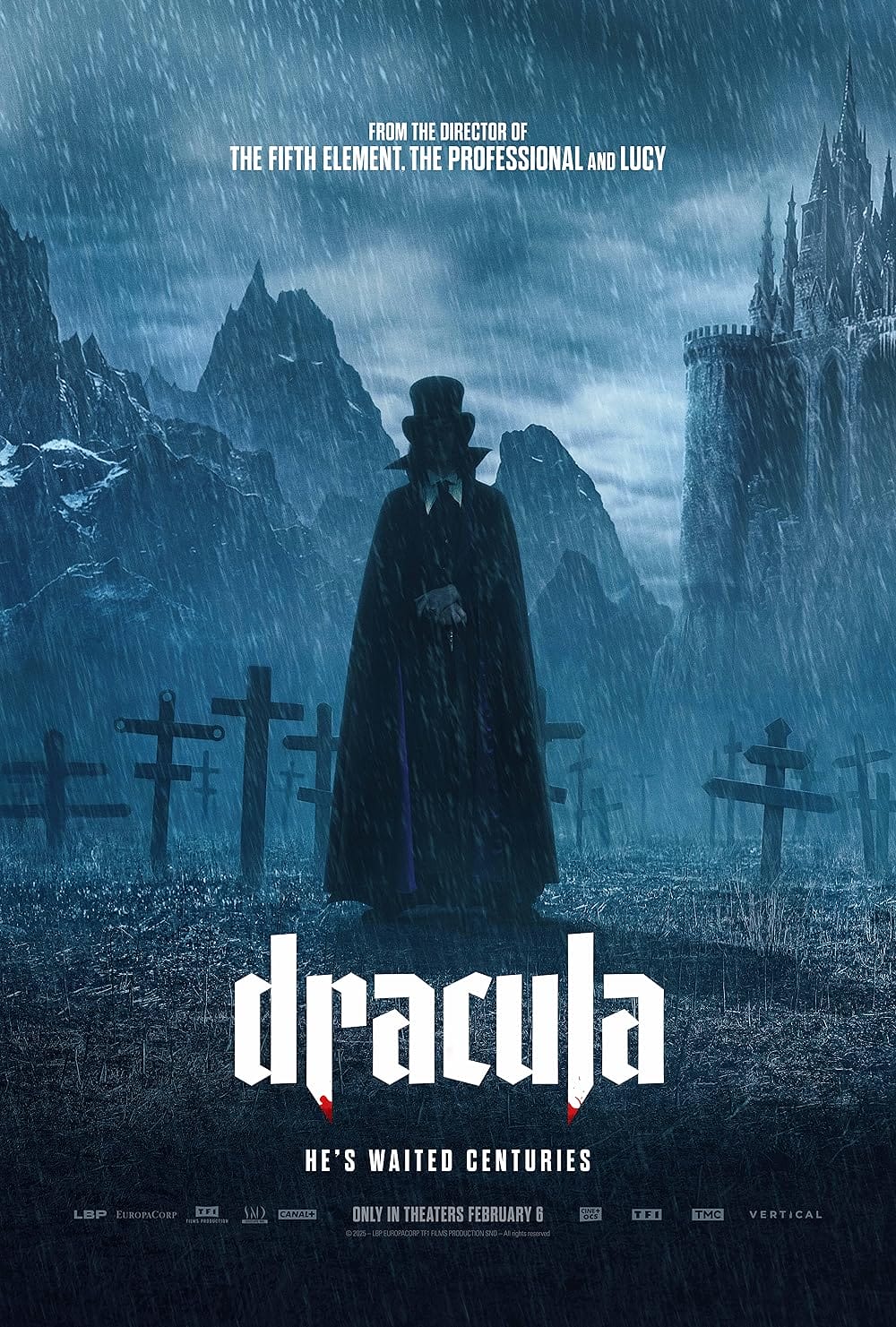
Photo via IMDb
By Keith Walther | Rose Law Group Reporter
There have been so many film adaptations of Bram Stoker’s classic 1897 novel, the count is somewhere between 200 and 500 films. “Dracula” is the latest, and it is an energy vampire, leaving the audience despondent or in full slumber that not even the end credits can resuscitate them. This particular story presents a love tale interpretation that is completely unnecessary.
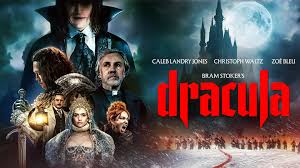
As a 15th century prince of Romania, Vlad (Caleb Landry Jones) has pledged his life to God, destroying his enemies in his name. When his wife Elisabeta (Zoë Bleu) is killed, he immediately denounces God, thereby inheriting an eternal curse of becoming Dracula. For the next 400 years, he searches for the reincarnation of his true love, finally finding her in France going by the name of Mina (Zoë Bleu). A reunion won’t be easy, though, for a Priest (Christoph Waltz) has been hunting the abomination, looking to end his reign of terror.
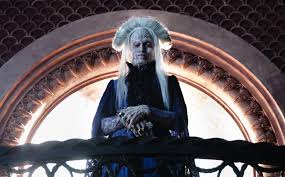
From key plot points to visual style to character interpretations, filmmaker Luc Besson repeatedly steals from Francis Ford Coppola’s 1992 film rather than adapting straight from the source material. Both the reincarnation plotline and Dracula’s rejection of God is directly taken from Coppola’s version, and even the gothic aesthetics, not to mention Dracula’s look down to his hairstyle, is a carbon copy as well. This isn’t the first time the French director, who also wrote the screenplay, has been accused of plagiarism, having previously been ordered by a Parisian court to pay nearly €450,000 for plagiarizing John Carpenter’s 1981 film, “Escape from New York,” when creating his 2012 movie, “Lockout.” In addition to ripping off Coppola’s version, Besson clearly pilfers from 2006’s “Perfume: The Story of a Murderer” by having the Dracula character use a perfume to make himself irresistible, rather than supernatural powers as described in the novel. If only this was the least of his failings with this production.
The amount of filmmaking errors Besson makes throughout this film is criminal, showing his laziness and inattention to detail. He’s basing this Dracula character on the historical figure Vlad II but set the story in 1480, years after his actual death. He also makes a geographical blunder showing France and Romania share a border, which couldn’t be more inaccurate as there are several countries in between and would certainly take more than a few hours to traverse by horseback. There are inventions and landmarks shown that did not exist in the timeframes being depicted, like the Eiffel Tower in the background of a scene set in 1880, yet that famed architecture wasn’t completed until 1889. There are costuming errors, religious contradictions, and laughable logic flaws such as an army firing artillery at a castle their own infantry is entering at the same time.
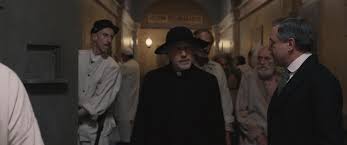
Then there’s the sleep-inducing pacing Besson employs from the very beginning that makes the over 2-hour runtime an absolute slog to get through, compounded by the dry narration from the titular character as he recounts his past 400 hundred years. About midway through, the overly calming musical score is accompanied by a consistent drone of snoring from roughly half the audience…this is not an embellishment. He inexplicably introduces a music video montage sequence as a poor stylistic attempt to liven things up, but the sudden tonal shift presents a silliness that feels out of place and tone deaf. Making matters significantly worse are Dracula’s CGI gargoyle army that behave more like the Seven Dwarfs than the frightening stone imps they’re supposed to be.
The actors in this film should not shoulder any of the blame for this embarrassment. Both Caleb Landry Jones and Zoë Bleu demonstrate believable romantic chemistry that enable impassioned performances. Two-time Oscar winner Christoph Waltz seems to be completely confused with this role and is clearly given no direction as to how he should approach it, leaving his performance uneven and inconsequential.
Seeing this lifeless husk of a movie will make you want to drive a stake through your own heart or at the very least eat a pound of raw garlic. “Dracula” is boring without a single fear-inducing moment or even a hint of suspense, and it exposes Luc Besson as the thief that he is, pilfering from other directors without remorse. Leave this sorry excuse for an adaptation buried under a mound of indifference never to see the sunlight.
This movie earns: