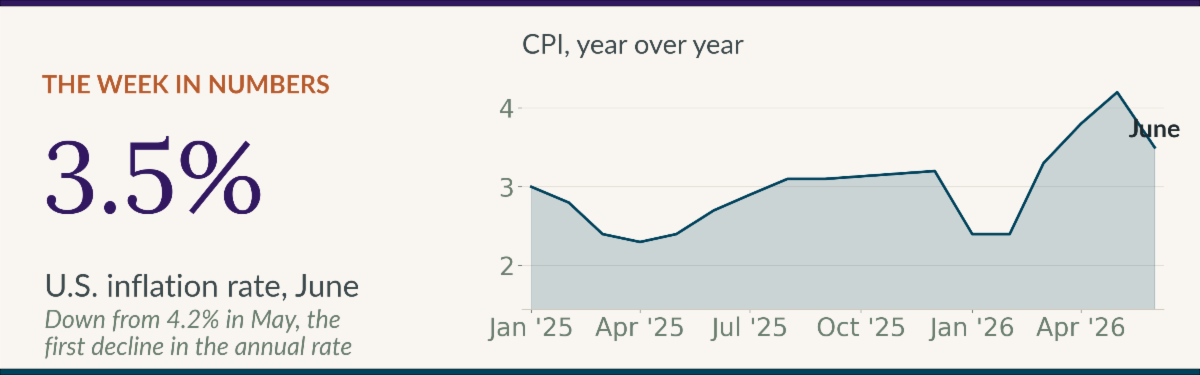
Inflation finally gave a little ground. The Consumer Price Index rose 3.5% over the 12 months ending in June, down from 4.2% in May and the first decline in the annual rate since January. Core inflation, which strips out the volatile food and energy categories, eased to 2.6% from 2.9%. After a slew of sticky readings, last month was the direction we needed to be heading.
The relief came mostly out of the gas tank. Energy prices fell sharply in June as crude oil retreated, and the wholesale data told the same story. The Producer Price Index, which measures prices at the factory gate before they reach the consumer, actually fell 0.3% on the month, its largest drop since April 2025, with gasoline down 12%. Lower pump prices ripple through the whole economy, and for one month at least they pulled the headline number down with them.
That matters because the Fed meets at the end of July, and two weeks ago its own minutes showed a committee split right down the middle on whether to raise rates again this year. A softer inflation print takes some of the heat out of that argument. It does not settle it. One month is not a trend, and the Fed has said again and again that it wants to see a string of good readings before declaring victory. But a 3.5% number is a good deal easier to sit still on than a 4.2% one. We continue to expect the Fed to hold, and this report makes that hold an easier call.
Here locally, the signals are mixed, and worth untangling. Arizona’s employers are still hiring at a respectable pace. The state added 27,900 jobs over the past year, a 0.9% gain that actually runs ahead of the nation’s 0.3%, and June’s seasonal payroll dip was smaller than the pre-pandemic norm for the month. But the household side of the data softened. The state’s seasonally adjusted unemployment rate rose to 4.9%, up from 4.8% in May and now well above the 4.2% national rate, while the labor force shrank, both on the month and by 1.9% over the year. As Doug Walls, the state’s chief economist, summed it up, positive payroll growth “remains an encouraging sign,” but rising unemployment and a declining labor force “suggest broader labor market conditions softened” as Arizona entered the second half of the year.
The housing numbers add to that mixed picture. According to RL Brown Reports, new home closings across Metro Phoenix ran 17.4% below a year ago in June, and 16.9% below on a year-to-date basis, though resales held up better, up 4.3% year to date. Permit activity jumped both month over month, up 25.5%, and against the same month a year ago, up 12.8%, though permits are still running about 5% below the 2025 year-to-date pace.
The Phoenix-area inflation rate, at 2.8%, came in comfortably below the national figure, though the pullback was concentrated in energy; core prices actually firmed to 2.0% from 1.7% in the prior reading. So the local economy is not stalling. Job growth still tops the nation’s and resales are steady. But a rising jobless rate, a shrinking labor force, and softer homebuilding are cross-currents worth watching after years of clear Arizona outperformance.
U.S. Snapshot
Retail sales rose 0.2% in June to $768.6 billion, a touch below the 0.3% consensus, and stand 6.7% above a year ago. A 5.3% drop in gasoline station receipts held the headline down; excluding gas, sales were up 0.7%. The consumer is still spending, just carefully.
Housing starts jumped 19.0% in June to a 1.427 million annual rate, but the gain was entirely in apartments, where starts soared 76%. Single-family starts were essentially flat, and building permits, the better gauge of what builders plan to do next, fell 3.0% to 1.367 million.
The NAHB/Wells Fargo Housing Market Index slipped two points to 34 in July, its 15th straight month below 40 and well under the 50 line that separates optimism from pessimism, as the 30-year mortgage rate ticked up to 6.55% from 6.49% a week earlier.
Industrial production was flat in June, with manufacturing output up a bare 0.1%. The regional factory surveys were far livelier: the Empire State index jumped to 15.6 from 5.7, and the Philadelphia Fed index vaulted to 41.4 from 10.3, its strongest reading since November 2021.
Initial jobless claims fell 8,000 to 208,000 in the week ending July 11, below the 217,000 economists expected. Layoffs remain low even as hiring has slowed.
Consumer sentiment is perking up. The University of Michigan’s preliminary July index rose to 54.4, a five-month high, as cheaper gas lifted spirits, and consumers’ one-year inflation expectations eased to 4.2% from 4.6%.
Arizona Snapshot
Arizona’s job market sent mixed signals in June. Employers added 27,900 jobs over the year, a 0.9% gain that still outpaces the nation’s 0.3%, led by health care and social assistance (16,800) and professional and business services (12,700). But the household survey softened, with the seasonally adjusted unemployment rate rising to 4.9%, above the 4.2% national rate, as the labor force shrank.
RL Brown Reports puts Metro Phoenix new home permits at 1,980 in June, up 12.8% for the month but still down about 5% year to date, with the median resale price at $450,000, up 2.3% from a year ago, and the median new home price at $482,990, down 1.6%.
The Phoenix-area Consumer Price Index rose 2.8% over the year ending in June, down from 3.0% in April. The deceleration was all energy; core prices actually firmed to 2.0% from 1.7%.
Arizona taxable sales for May, the latest reported, rose 3.1% from a year ago statewide, with retail up 2.3%, and Maricopa County total sales up 3.4%. Spending is still growing, but the pace has cooled from last year’s clip.