By Elliott D. Pollack & Company
The June jobs report was somewhat of a dud. Employers added 57,000 jobs last month, less than half the 115,000 that forecasters expected and the weakest showing in months. The Bureau of Labor Statistics also revised the two prior months lower, taking 43,000 off May and 31,000 off April, so that hiring over those two months was a combined 74,000 weaker than first reported. However, the 3-month average is still above 100,000 jobs added per month, which is solid territory. A week ago, after an inflation reading that came in hot, we wrote that if hiring held up the Fed had every reason to keep waiting. Hiring did not hold up.
The one number that looked good was misleading. The unemployment rate fell to 4.2% from 4.3%, but it fell for the wrong reason. The decline reflected a contraction in the participation rate, which dropped 0.3 percentage point to 61.5%, its lowest since March 2021, rather than more people finding work. When people stop looking for a job, they are no longer counted as unemployed, and the rate can fall even as the labor market weakens. The Fed’s rule of thumb is that it takes roughly 100,000 new jobs a month just to absorb those entering the labor force. At 57,000, June fell well short of that mark.
The internals were soft and somewhat confusing. Leisure and hospitality reportedly lost 61,000 jobs, which the Labor Department attributed to slower-than-usual seasonal hiring. That’s a head-scratcher given the surge in international visitors for the FIFA World Cup tournament (estimated to be over 1.2 million visitors). So, either that may be revised later, or there was more underlying weakness in the sector than even a tourism mega-event could overcome. The decline in leisure and hospitality masked continued gains in professional and business services (up 36,000), social assistance (up 25,000), and health care (up 22,000). Hiring that is happening remains concentrated in a narrow set of industries. Wage growth also cooled. Average hourly earnings rose 0.3% on the month and 3.5% from a year ago, a pace that is slowing but is still a touch firmer than the Fed would like to see.
The rest of the week’s labor data told the same story. ADP’s tally of private payrolls rose a below-forecast 98,000 in June, down from 122,000 in May. Job openings held at 7.6 million in May, the highest since May 2024, but the quits rate stuck at just 1.9%, well below its pre-pandemic norm and a sign that workers are not confident enough to jump ship. And the Conference Board’s June survey showed the share of consumers who say jobs are hard to get climbing to 22.5%, the highest reading since January 2021. The job market is not falling apart, but it is plainly loosening.
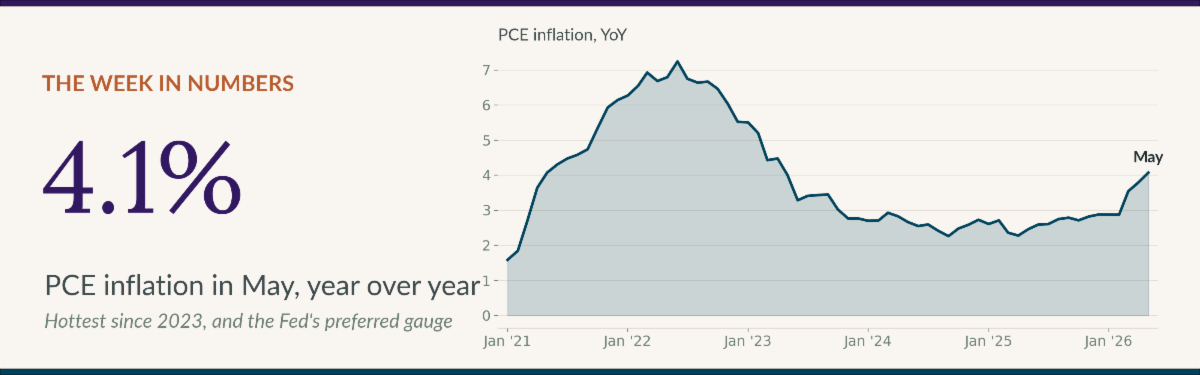
Here is the complication for the Fed. A week ago the problem was inflation, with the PCE price index up 4.1% from a year ago and still climbing. The jobs situation isn’t helping. The Fed has two mandates, stable prices and maximum employment, and they may be pulling in opposite directions again. A soft jobs number hands the doves on the Committee the argument for a cut this summer. A 4.1% inflation rate hands the hawks the argument to keep waiting. Both cannot win.
One weak report does not make a trend, and there is a wide margin of error in the payroll survey. So all we can do is wait to see whether June is an aberration or the start of something. The next real test comes with the June inflation reports in the middle of this month. After a hot price print and now a cooler jobs print, those numbers will go a long way toward telling us which mandate the Fed is watching most closely.
U.S. Snapshot
Nonfarm payrolls rose 57,000 in June, below the 115,000 expected, and April and May were revised down by a combined 74,000. The unemployment rate slipped to 4.2% from 4.3%, but only because the labor force participation rate fell to 61.5%, its lowest since March 2021.
ADP reported private employers added 98,000 jobs in June, down from 122,000 in May and short of the roughly 110,000 expected. Nearly half the gain came from education and health services.
Job openings were essentially unchanged at 7.6 million in May, the highest since May 2024. The quits rate held at 1.9%, well below the pace that signals worker confidence.
The ISM Manufacturing index eased to 53.3 in June from 54.0 in May, but it was still its 20th straight month above 50. Any reading above 50 signals expansion, so factories are still growing, just a bit more slowly. The prices index dropped sharply to 73.0 from 82.1, a welcome sign on the inflation front even as it points to raw-material costs still rising.
The Conference Board’s Consumer Confidence index inched up to 91.2 in June from 90.6, but stayed below the 94.4 expected. The details were softer than the headline, as the share of consumers saying jobs are hard to get rose to 22.5%, the highest since January 2021.
Auto sales were a bright spot for the consumer. Light-vehicle sales rose to a 16.9 million seasonally adjusted annual rate (SAAR) in June, up from 16.5 million in May and 16.3 million a year ago, the strongest month of 2026 so far. Even with high financing costs, households kept buying.
Factory orders fell 1.3% in May, dragged down by a 4.5% drop in durable goods orders that was almost entirely a swing in aircraft. Excluding transportation, orders rose 1.3%.
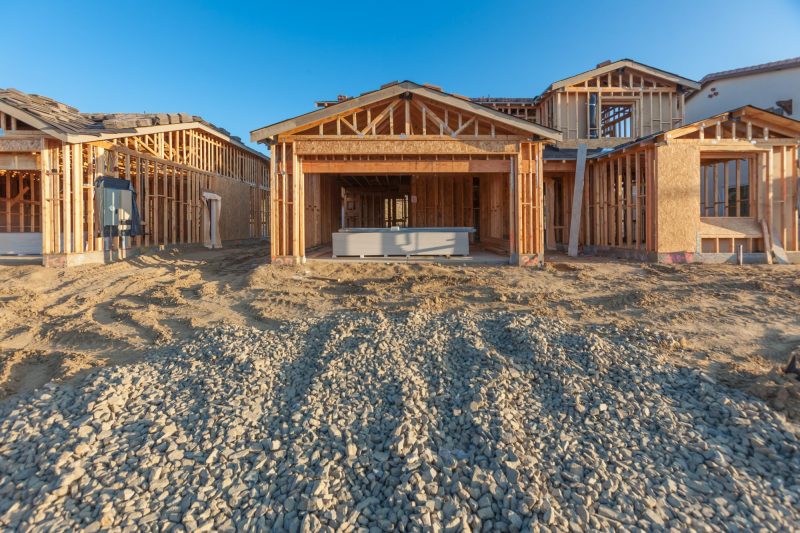
Construction spending was nearly flat, up 0.1% in May, and stood 1.5% below a year ago as homebuilding stayed weak.
Initial jobless claims fell to 215,000 in the week ending June 27, the lowest in five weeks, though continuing claims rose to 1.81 million, a three-month high. Layoffs remain low even as hiring slows.
The 30-year fixed mortgage rate averaged 6.43%, a seven-week low, down from 6.49% a week earlier and 6.67% a year ago.
Arizona Snapshot
Arizona’s economy slowed to start the year. Real GDP in the state grew at a 1.4% annual rate in the first quarter of 2026, below the 2.1% national pace and down from 1.5% in the prior quarter, though up sharply from a 3.8% contraction a year ago, according to the University of Arizona’s Economic and Business Research Center analysis of the Bureau of Economic Analysis data released June 25. Growth was led by manufacturing, information, government, and professional and business services, while construction, finance and real estate, leisure and hospitality, and trade declined.
Personal income told a similar story. Arizona personal income rose 4.8% at an annual rate in the first quarter, but net earnings from work advanced just 2.0%, behind the 3.1% national gain, with much of the increase instead coming from transfer receipts, which jumped 12.4%. At $69,728 on an annualized basis, Arizona’s per-capita personal income was 89.6% of the national average, and the state slipped to 36th in the nation in 2025 from 33rd in 2024.
Homebuilding permits kept sliding. Arizona issued 2,961 residential building permits in May, down 34.4% from a year ago, with single-family permits off 21.6% to 2,537, according to Census Bureau data compiled by the University of Arizona EBRC. Greater Phoenix accounted for 2,255 of the total, with its single-family permits down 16.3% from a year ago, and Greater Tucson posted 319, also well below last year’s pace.
The S&P Cotality Case-Shiller index for April showed Greater Phoenix prices down 1.7% from a year ago, one of the steepest declines among the 20 large metros, while the national index was up 0.8% and Chicago led at 6.5%. Phoenix remains among the softest big-city housing markets in the country.
On a more encouraging note for local buyers, the drop in the 30-year mortgage rate to a seven-week 6.43% comes as national pending home sales rose 3.8% in May and 4.8% from a year ago. As NAR’s chief economist put it, buyers are increasingly treating above-6% mortgage rates as the new normal, a shift that could gradually support demand in Arizona.
Finally, new Census Bureau population estimates underscored the state’s aging trend. Arizona’s median age reached 39.4 in 2025, matching the national median and up from 38.7 in 2020, with the 65-and-older group the fastest-growing age segment both in Arizona and nationwide.