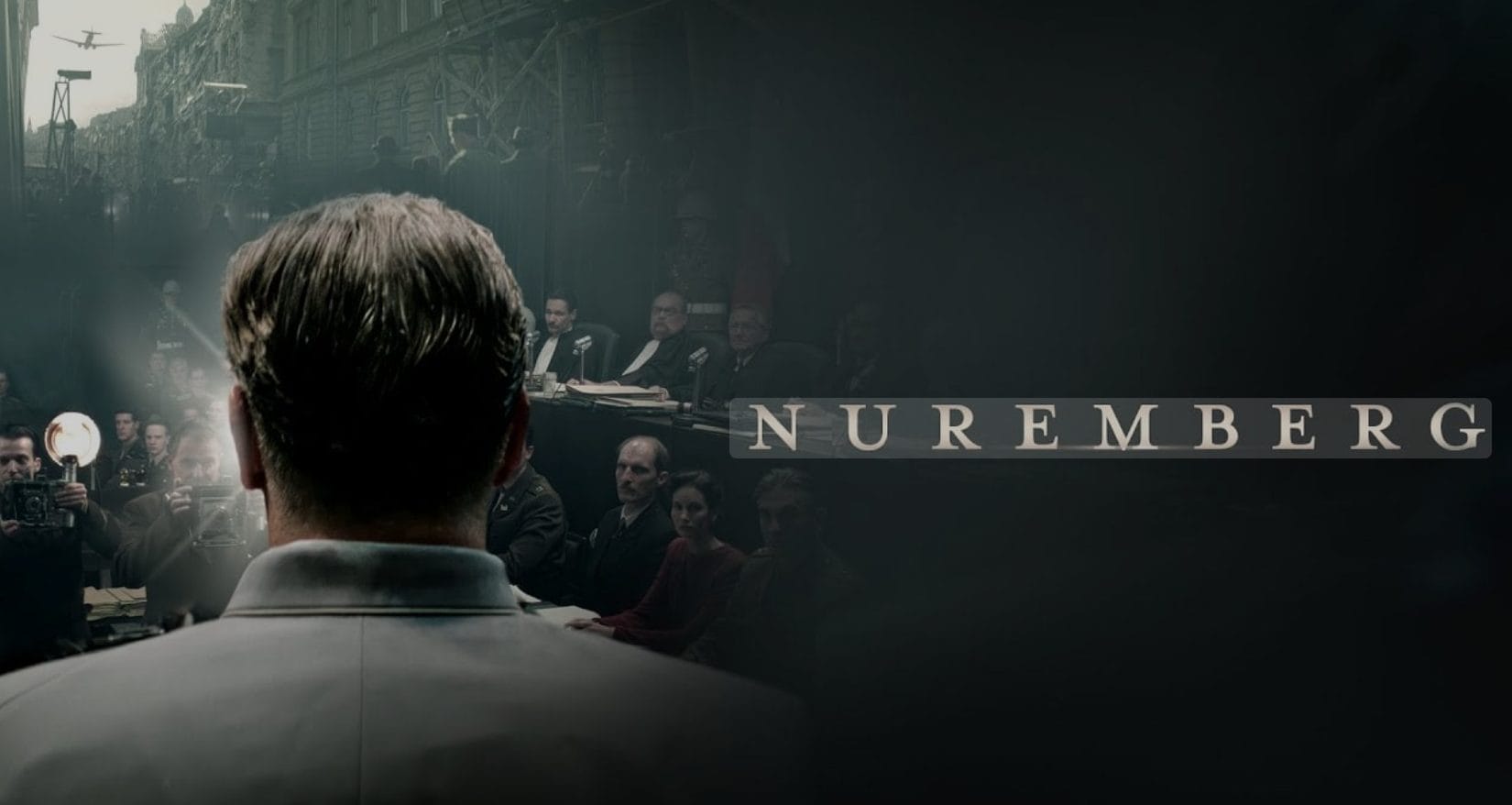
Photo via movieinsider.com
By Keith Walther | Rose Law Group Reporter
Considering this film focuses on one of the most famous war trials in history, a fizzling emotional impact defies expectations. “Nuremberg” is based on the true story of the Nuremberg trials shortly after WWII as well as the 2013 nonfiction book, “The Nazi and the Psychiatrist” by Jack El-Hai. While the integrity of the actual events is upheld and is quite fascinating, there is a missed opportunity for emotional connectivity to make this film truly great.
In the aftermath of WWII, as the world begins to learn the truth of Nazi concentration camps and the atrocities of the Holocaust, the captured Nazi leaders await trial in Nuremberg. One of these leaders is none other than Hermann Göring (Russell Crowe), the second in command of the Third Reich who was Hitler’s successor. To gain insight to his mentality and defense strategy, Chief U.S. Prosecutor Robert H. Jackson (Michael Shannon) recruits an Army psychiatrist named Douglas Kelley (Rami Malek) to get close to Göring and earn his trust. As a disturbing bond develops between the two, loyalties are put to the test that could drastically alter the trial’s outcome.
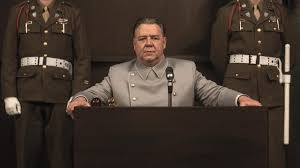
This is only the second feature film James Vanderbilt has directed, the first being 2015’s “Truth,” another drama based on a true story. Covering the Holocaust is a daunting challenge for the most experienced of directors, but Vanderbilt, to his credit, upholds the integrity of the actual events as they transpired. He draws from a variety of source material, including transcripts of the actual trial and Douglas Kelley’s book about his involvement, to ensure complete accuracy with this reenactment with very few Hollywood-like embellishments. He even incorporates the actual footage of concentration camps that was played during trials. This commitment successfully captures the audience’s trust and attention in the retelling.
Despite a two-and-a-half-hour runtime, Vanderbilt achieves smooth pacing with very little drag. However, the tone is misaligned with the heaviness of the topic, which prevents this film from approaching greatness. He often uses glib, offhanded remarks and one-liners that confuse from the grievousness of the situation. The oddly placed levity is off-putting, severing emotional connections. Coupled with a main character who humanizes and seems to befriend a monster, the lack of relatability becomes an issue that extinguishes a more intensely passionate response.
Through scenes of mental maneuvering where the main characters are each trying to manipulate one another for their own motivations, Vanderbilt does well building the anticipation for the eventual showdown that is the trial. He presents this in a way that is fascinating and thought-provoking regarding morality and good vs. evil and the gray that lies between the two. There’s also a clever insertion that makes viewers draw a comparison to modern society of history repeating itself. Without the key ingredient of emotional connectivity, however, Vanderbilt lets the climactic trial regress into a forgettable conclusion.
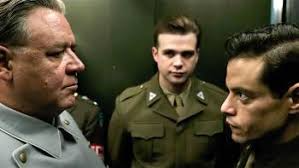
The commitment to authenticity extends to the cast as well, with Oscar winner Russell Crowe (“Gladiator”) leading the way. He gives a strong, commanding performance, speaking both German and English with a convincing German accent throughout the entirety of the movie. He does well exhibiting a narcissistic charm with his character while hiding the cold and calculating monster within while he plays mental chess with the other characters. This is unquestionably his finest performance in recent years.
The rest of the cast gets the job done, but none stand out in a meaningful way. Oscar winner Rami Malek (“Bohemian Rhapsody”) plays this psychiatrist with questionable morals and ethics that seem to corrupt his motivations, making him a somewhat unlikable character. Two-time Oscar nominee Michael Shannon (“Nocturnal Animals” and “Revolutionary Road”) provides a straightforward performance as the U.S. prosecutor with ambitions to use these trials as a platform to promote himself as a viable Supreme Court Justice.
This is a movie that is decent and accurately conveys the events of that historic trial, but without the gravitas, it comes up short as a true Oscar contender. “Nuremberg” pales in comparison to the 1961 Oscar winning film from the great Stanley Kramer, “Judgment at Nuremberg,” featuring the likes of Spencer Tracy and Burt Lancaster. So, if anything, see that classic first and foremost before spending the time and money on this one.
This movie earns: