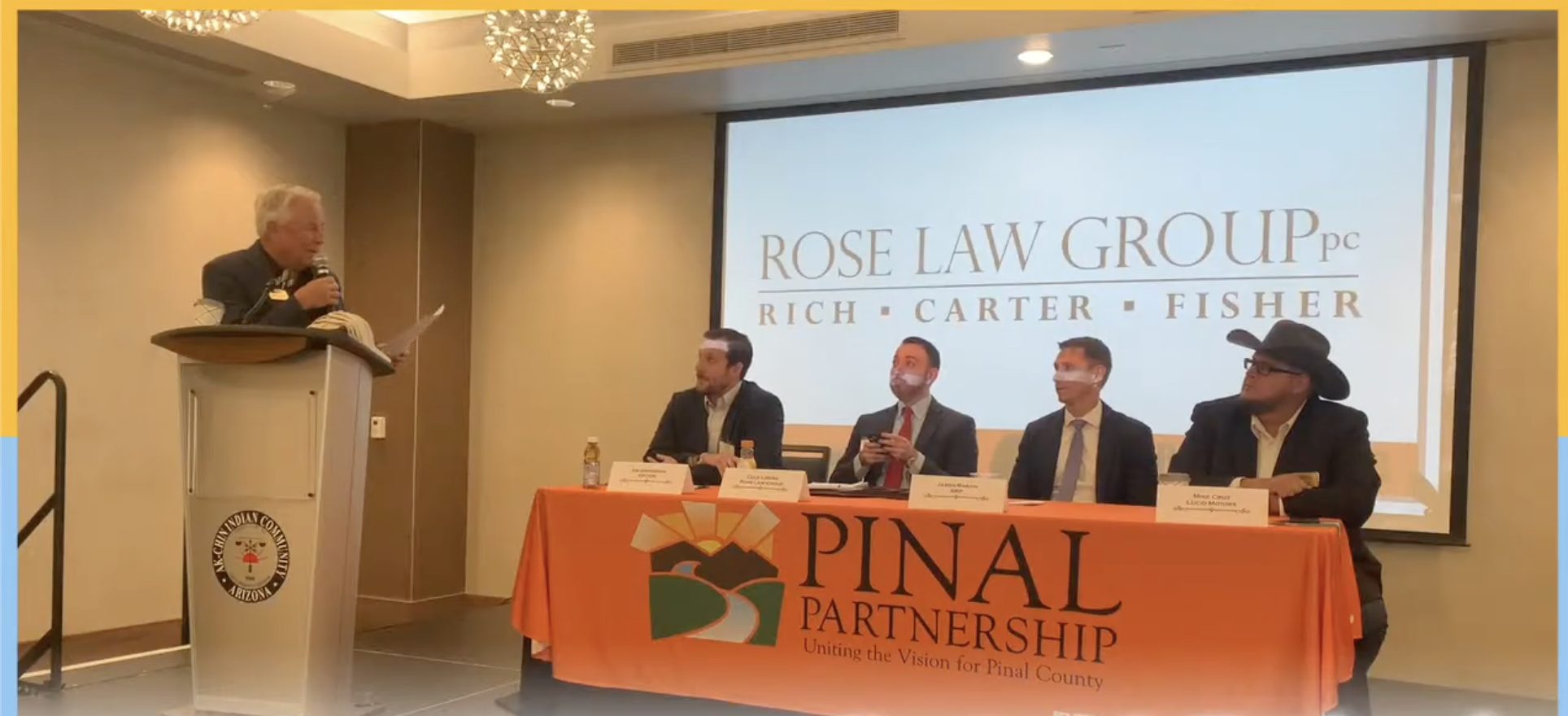
Panelists:
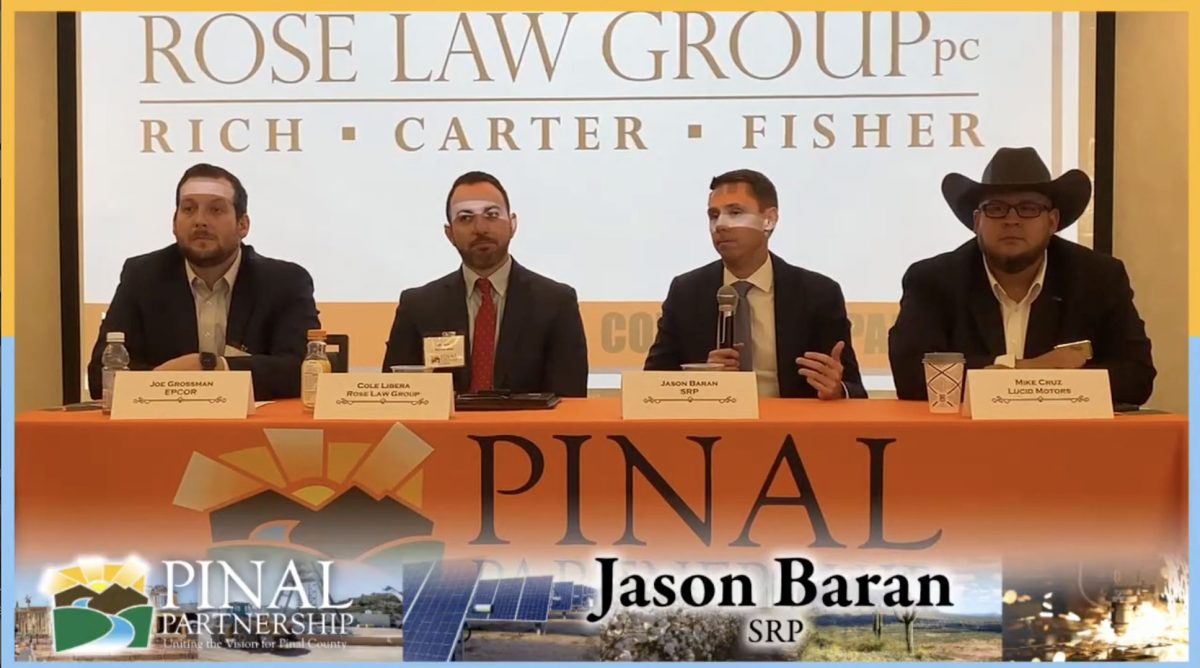
Jason Baran, SRP
Michael Cruz, Lucid Motors
Cole Libera, Rose Law Group
Joe Grossman, EPCOR
Moderated by: Craig McFarland, President and CEO of Pinal Partnership
By Hannah Kovach, Digital Media Intern | Rose Law Group Reporter
Water policy, energy reliability and economic development dominated discussion at the February Pinal Partnership breakfast, as industry leaders and lawmakers warned that 2026 could be a defining year for Pinal County.
The panel, moderated by Pinal Partnership President and CEO Craig McFarland, featured Jason Baran of Salt River Project, Michael Cruz of Lucid Motors, Cole Libera legislative lobbyist and Deputy Director of Government Affairs at Rose Law Group, and Joe Grossman of EPCOR.
McFarland opened the event with a sobering overview of the legislative session, noting that lawmakers have introduced a record-breaking number of bills just weeks into the year.
“We broke the record, by a lot,” McFarland said. “As Joe said, that’s not a good thing.”
With more than 2,000 bills introduced between the House and Senate, McFarland outlined looming deadlines for committee hearings and votes, signaling that many proposals will fall away as timelines tighten.
With this incoming surge of legislation, Libera outlined the high-stakes budget and policy fights already taking shape at the Capitol.
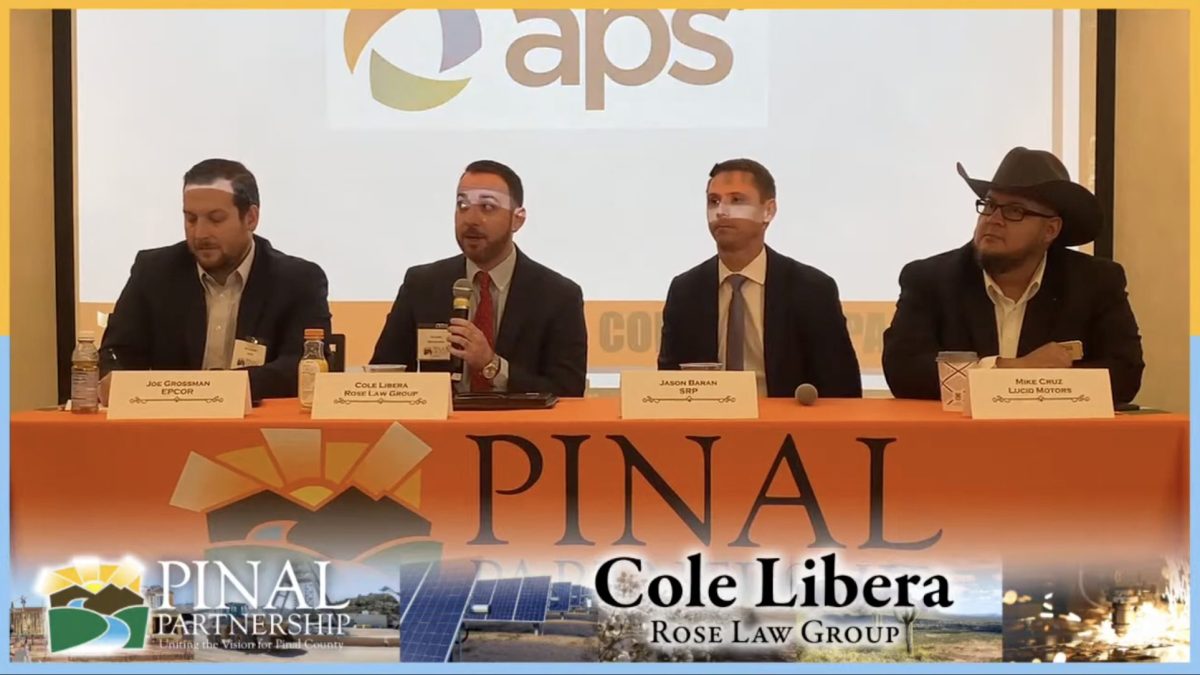
“Conformity is like $1.45 billion. And we’re already in a pretty lean fiscal year,” Libera said.
An early full-conformity bill was vetoed, and Libera said negotiations between Republican lawmakers and the governor are expected to continue as budget talks unfold.
Beyond the budget fight, Libera highlighted House Bill 2988, which would clarify bonding authority for the Pinal County Water Augmentation Authority, describing it as a practical step toward strengthening long-term water security.
“It just clarifies that Pinal County is able to bond,” Libera said.
Libera also discussed House Bill 2824, known as CPACE, an economic development financing tool that would allow commercial property owners to secure private loans repaid through a voluntary property tax assessment.
“It’s just a tool,” Libera said. “You don’t have to do it. It’s voluntary.”
He said the program could help developers, manufacturers and agricultural operators modernize facilities and invest in water- and energy-efficient upgrades without significant upfront capital.
Libera described the Legislature as more cohesive among Republican members compared to last year, though he said veto battles remain likely in an election year.
“It’s going to be a wild year,” Libera said.
Grossman framed the legislative session as a pivotal moment for Arizona, with water policy and tax conformity at the center of high-stakes decisions that will shape the state’s economy.
“I think we’re at a very critical time in the state’s history,” Grossman said.
Nearly 100 water-related bills are circulating at the Capitol, he added, reflecting both the urgency and the uncertainty surrounding long-term supply, Colorado River negotiations and groundwater management.
“We are trying to figure out moving forward what industries we’re trying to support,” Grossman said.
The conversation repeatedly returned to the Colorado River and the risk of deeper cuts. Grossman warned that negotiations between upper and lower basin states remain strained and said so-called “dead pool” scenarios, in which water levels drop too low to generate hydropower, cannot become reality.
“We can’t go into dead pool, that’s completely unacceptable,” Grossman said.
He argued the state cannot continue absorbing disproportionate reductions.
As lawmakers wrestle with water scarcity and a costly tax conformity debate, energy reliability has emerged as another high-stakes priority shaping Arizona’s economic outlook.
Jason Baran of Salt River Project said energy policy is now under unprecedented scrutiny at both the national and state levels, with dozens of bills aimed at utilities, data centers and grid operations.
“Energy has been on the national narrative and now the state narrative in a way that it has not been in my career,” Baran said.
Even amid that scrutiny, he emphasized Arizona’s grid remains strong.
“We have an extraordinarily reliable grid. We’ve got that great foundation,” Baran said.
He urged lawmakers to build carefully rather than overhaul systems that are already working.
“Where can we make marginal improvements but also not do damage while we’re chasing the shiny object?” Baran said.
Michael Cruz of Lucid Motors widened the lens to federal trade policy, saying uncertainty around the United States-Mexico-Canada Agreement is creating ripple effects for manufacturers across Arizona.
“Trade is the 800-pound gorilla in the room,” Cruz said.
He noted that evolving electric vehicle supply chains make strict domestic sourcing requirements difficult.
“Even if I wanted to use every battery supplier in this country, you can’t,” Cruz said.
Cruz also pointed to House Bill 2939 and Senate Bill 1371, which would update tax credit structures and modernize manufacturing definitions so that contiguous and non-contiguous supporting parcels in rural counties are recognized.
“What this legislation does is update the definition to ensure that contiguous and non-contiguous supporting parcels are recognized,” Cruz said.
As the discussion closed, McFarland urged continued engagement from business and community leaders as bill deadlines approach.
“We need everybody’s eyes and ears,” McFarland said.
Panelists agreed that whether the issue is tax conformity, water allocation or grid reliability, the path forward will require coordination between lawmakers, utilities, manufacturers and local governments, with water conservation and fiscal discipline driving the decisions at the top of the agenda.