
(Disclosure: Rose Law Group represents Pinal Partnership.)
By Madelaine Braggs | Rose Law Group Reporter
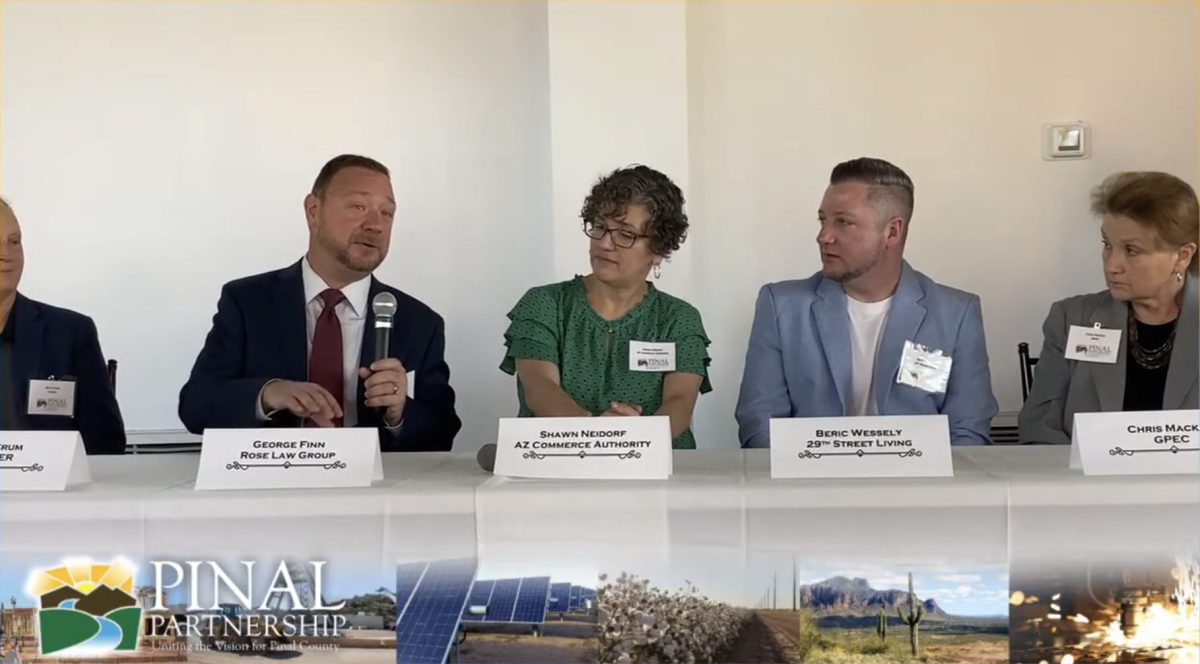
At a recent Pinal Partnership breakfast, Jordan Rose, Founder and President of Rose Law Group, moderated a wide-ranging discussion on Opportunity Zones. The panel featured George Finn, Rose Law Group Partner and Attorney focused on business and corporate transactions, opportunity zones, and estate planning; Christine Mackay, President of Greater Phoenix Economic Council; Shawn Neidorf, Ph.D., Senior Vice President of Research at the Arizona Commerce Authority; Brion Crum, Co-Founder and Managing Partner at Caliber; and Beric Wessely, Managing Director at 29th Street Living. Together, they examined both the mechanics and real-world outcomes of a federal program that has quietly redirected billions into underserved communities.
Opportunity Zones, first introduced in 2016, were designed as a tax incentive to drive capital into distressed areas. As Christine Mackay of GPEC explained, “they allow capital gains funds to be put into opportunity zone funds to allow a tax deferral on capital gains and then for the profits of those particular projects to be tax exempt if people hold them for greater than 10 years.” The intention, she emphasized, was straightforward: “to encourage redevelopment in areas that were challenged.”
Mackay underscored the program’s practical impact in Arizona, where local leaders strategically selected qualifying census tracts. “The program could not have worked better,” she said. “It did exactly what it was supposed to do, which was get redevelopment to happen in areas that otherwise would not have happened.” In Phoenix alone, she noted, “something happened in virtually every one of our opportunity zones.”
Tax Advantages
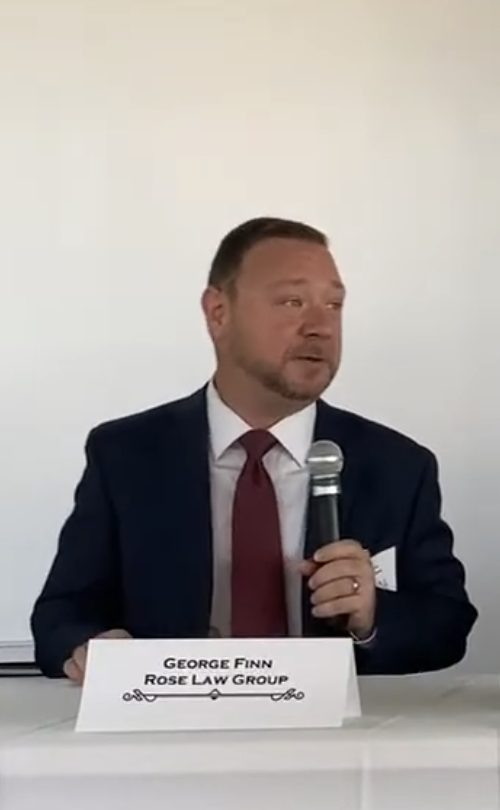
Finn, providing a legal framework, said, “Prior to opportunity zones, you had 1031 exchanges that were specifically limited to real estate. Whereas now you can take capital gains funds from a sale of an asset and deploy that into these opportunity zones and get a deferral on your tax basis.” Over time, the benefits compound: “if you hold the asset for a certain period of time, then really you get a step up in basis… you can also eliminate the depreciation recapture.”
He added that investors often underestimate the full scope of the benefit: “what a lot of people also don’t realize is not just the step up in basis, but you can also eliminate the depreciation recapture.”
Finn translated the policy into plain terms. “Once you sell… a large amount of stock and you realize those capital gains, you can deploy that within an opportunity zone and start to receive the benefits,” he said, noting that under the next phase of the program, investors will be able to “defer those on a rolling basis five years from when it was invested in the fund.”
He also pointed to new incentives designed to steer capital toward rural areas, where investment has historically lagged. “They’ve also implemented a rural designation… where you can get a 30% step up for the tax that would have been due on that capital,” Finn said, describing the changes as “really beneficial for going forward.”
The first iteration of the program was not without blind spots. Shawn Neidorf of the Arizona Commerce Authority pointed to a critical limitation: “There were no reporting requirements in the first opportunity zones.” As a result, while investment surged—“more than $26 billion, more than any state in the country other than California”—the precise distribution and impact remained difficult to quantify. Still, she noted a key success: “In Arizona, it was 72%,” referring to the share of eligible tracts that received investment, far exceeding the national average.
Simplifying Complicated Policy
The program’s evolution comes with complexity—particularly for existing investments. “If you have a current investment in opportunity zone 1.0… you have to be careful with the capital,” Finn cautioned. “There is a little ambiguity in the regulations… most expect that it will be grandfathered,” he said, referring to how new boundaries and rules could affect legacy projects.
Developers on the panel reinforced that Opportunity Zones function less as a driver of deals and more as an accelerant. Brion Crum of Caliber described how his firm raised “a little over $220 million from other investors,” often deploying gains from assets ranging from real estate to cryptocurrency. The projects themselves, he said, reflected tangible outcomes: “when we built a behavioral healthcare hospital, we created 100 jobs… when we built the Tucson Convention Center hotel, it wasn’t just those jobs. It was the bigger impact in the whole downtown area.”
Beric Wessely of 29th Street Living framed the strategy more bluntly. “Opportunity zones are a tool. They’re not a silver bullet,” he said. His firm’s approach hinges on early action: “If you’re waiting for validation… you’ve already missed your mark.” By entering emerging markets first, he added, developers can “set the bar… set the market demand once we lease up and we start filling homes.”
The discussion repeatedly returned to a central theme: the dance between policy and practicality. Mackay highlighted the redevelopment of Paradise Valley Mall as a defining example, noting that “part of their capital stack has been in an OZ… it really helped elevate and change the area.” Her broader takeaway was measurable: “more than 25% of them were elevated out of a qualified census tract because of these developments.”
Signs of Good Growth
As the program transitions into its second phase, the parameters are tightening. Neidorf explained that “the standards are tighter, so they will be poorer tracks than they were before,” with eligibility thresholds shifting from “80% of the median family income” to “70%,” alongside stricter caps. The number of qualifying tracts has declined accordingly, a change she attributed partly to economic growth: “we simply have fewer tracks that are poorly off… that’s a good accomplishment.”
At the same time, the next phase introduces new incentives, particularly for rural areas. But the increased competition for designation—combined with unresolved federal guidance—has introduced uncertainty. “We’re waiting longer on Treasury than we thought,” Neidorf admitted, outlining unresolved questions around rural definitions and data gaps affecting dozens of census tracts.
If there was consensus among the panelists, it was captured in a closing remark from Neidorf that cut through the technical detail: “The benefits that come with an opportunity zone can make a good deal a great deal, but they cannot make a bad deal a good deal.”
For Arizona, where the program has already delivered billions in investment and reshaped entire corridors, the next chapter will test whether tighter rules and better data can sustain that momentum—or refine it into something more targeted, and perhaps more enduring. As the program becomes more competitive and data-driven, the margin for error narrows—rewarding those who pair financial strategy with grounded, long-term development vision.