It was a quiet week for economic data, but what did arrive all pointed the same way. S&P Global’s flash Purchasing Managers’ Index, an early read on business activity across the economy, rose to 53.6 in July, its highest in eight months. Any reading above 50 signals expansion, and both the factory and the service sides of the survey grew, with companies adding to their payrolls for the first time in three months. The people who compile the survey figure that pace is consistent with the economy growing at about a 2.0% annual rate this quarter, up from the 1.2% pace the same survey signaled in the spring.
The job market told a similar story. Initial claims for unemployment insurance, the weekly count of people filing for benefits after losing a job, fell to 187,000 in the week ending July 18. That was down 22,000 from the prior week and the lowest reading of 2026. Layoffs, in other words, are simply not the problem right now. Hiring has clearly cooled over the past year, but employers are holding on to the workers they already have.
With the Fed meeting this week, a firmer set of numbers gives the committee little reason to move and also takes some of the urgency out of the case for a cut. We continue to expect the Fed to hold, and this week’s data make that an easier call to sit with. It will be the next inflation reading, not this week’s activity data, that does more to settle the argument.
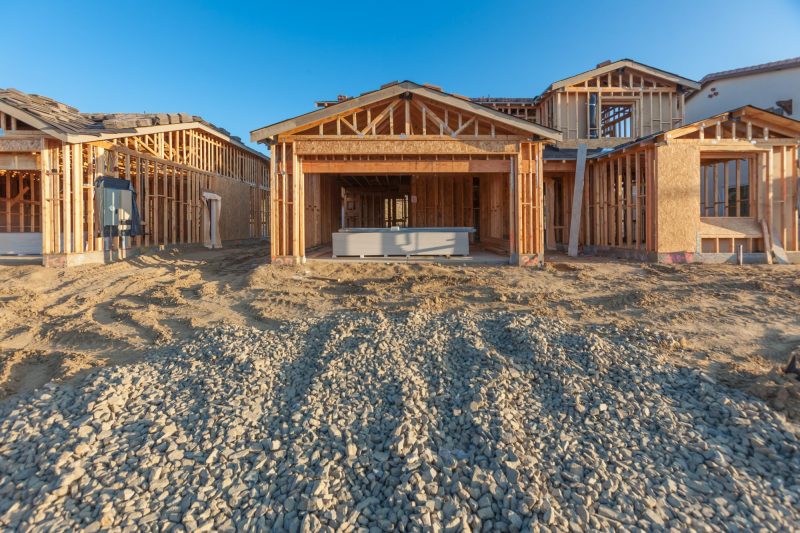
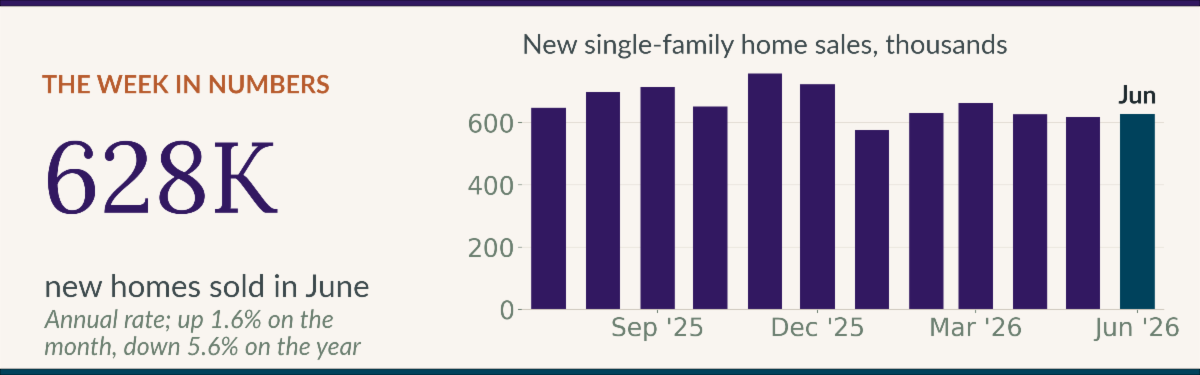
The one corner of the economy that is not humming along is housing. New single-family home sales rose 1.6% in June to a 628,000 annual pace, but that was still 5.6% below a year ago, and the supply of new homes on the market sat at a heavy 9.3 months. High prices and a 30-year mortgage rate stuck at 6.58% continue to keep buyers on the sidelines. Which brings us to Washington.
The 21st Century ROAD to Housing Act, signed July 11th, is a genuine step forward for manufactured housing, dragging rules written in the 1970s into the present, and it protects some rural subsidies and community banks. Cooler heads also stripped out early provisions that would have forced large owners of single-family rentals to sell and would have gutted the popular build-to-rent market. But on the core problem, the cost of building an ordinary single-family home, the bill does almost nothing, because most of that cost is piled on at the local level, where Washington has little say.
And that cost is not small. The National Association of Home Builders, in a study it runs every five years, finds that regulation now accounts for 26.4% of the price of the average new single-family home. On a home priced at $499,500 early this year, that works out to $131,734 of pure regulatory cost. Worse, over the past five years those costs have climbed more than 40%, while home prices themselves rose 29%. With all of the recent concern about affordability, there is still a lot of work to do at the local level to make an impact.
There is a bright spot. Inventory is normalizing. After nearly quadrupling between June 2021 and June 2025, the number of Arizona homes listed for sale is now slowly declining, and the national picture is leveling out as well. A market with more homes to choose from and steadier prices is a healthier one, even if it is not yet an affordable one.
U.S. Snapshot
The S&P Global flash composite PMI rose to 53.6 in July from 51.9 in June, an eight-month high, led by a jump in the services gauge to 53.6 from 51.2. Manufacturing held at 53.8. The survey pointed to a return to hiring after three months of cuts.
New single-family home sales ran at a 628,000 annual rate in June, up 1.6% from May but 5.6% below a year earlier. The median new-home price was $398,300, off 2.7% from a year ago as builders leaned on price cuts and incentives to move inventory.
Initial jobless claims fell to 187,000 in the week ending July 18, the lowest of the year, and the four-week average eased to 207,500. Continuing claims held near 1.8 million.
The Conference Board’s Leading Economic Index, a gauge built to anticipate turns in the economy, slipped 0.2% in June to 99.1, giving back part of the prior two months’ gains. Its rate of decline has slowed sharply from a year ago, and the Board nudged its 2026 growth forecast up to 1.9%.
The 30-year fixed mortgage rate edged up to 6.58% from 6.55% a week earlier, though it remains below the 6.74% of a year ago, according to Freddie Mac.