(Disclosure: Summit Land Management is a Rose Law Group-related company and contracted with the firm.)
By Paul Basha and Kayla Amado | Rose Law Group Reporter
What is your opinion of back-in parking?
Culture – often defined as the way we do things around here – can be quite narrow-minded.
In our country, only 6% of parking spaces are back-in. In China, 88% of parking spaces are back-in.
The diagram below is from a study and presentation I accomplished for a Phoenix suburb, approximately 15 years ago. We examined four different types of on-street parking, identifying the most disruptive maneuver of each. For back-in angle parking, entering the parking space is most challenging for all concerned.
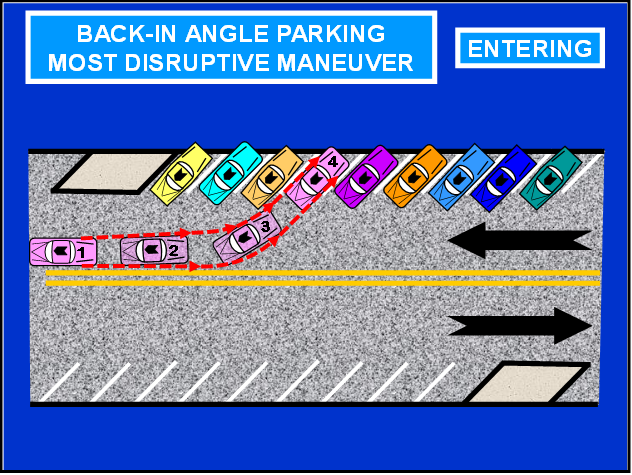
The driver must drive past the parking space, then stop in the moving traffic lane, then drive in reverse in the moving traffic lane, stopping all approaching traffic, to enter the parking space. (Much more difficult if the parking spaces are perpendicular to the driving lane.) (Much easier with back-up cameras – which are required for all new vehicles sold in the United States since 2018.)
When the business is complete and it is time to leave the parking space, the exit is very simple. These people passed the child two-marshmallow test big time! Difficult part first, easy part later.
I have been told that many combat veterans prefer back-in parking, as well as public safety officers, and people who work in hazardous materials plants. Those people are accustomed to a quick-exit need. Also, back-in parking provides quicker exits at busy locations like concerts, festivals, and athletic events. Plus, back-in parking allows easier loading for children and purchased items.
Exiting from our typical front-in parking configuration is most difficult. A driver needs to back-up into a moving traffic lane, forcing approaching traffic to stop, while the unparking vehicle changes from reverse to drive, before everyone can go.
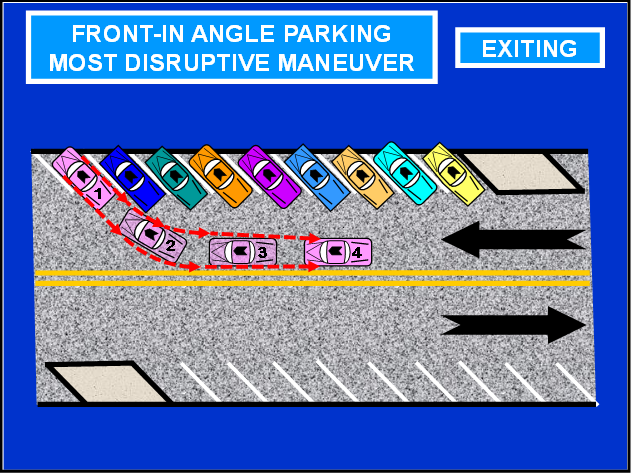
Advocates of front-in parking claim that this exit maneuver is less time-consuming than the back-in entering maneuver. Depends on the driver.
Angle parking spaces are much easier than perpendicular parking spaces, for both entering and exiting and for both front-in and back-in maneuvers.
Exiting perpendicular parking is rather difficult, and entering is not much better.
Parallel parking is better than perpendicular, though not as movement-efficient as angle parking. Studies have revealed that parallel parking requires 21 seconds, while angle parking requires 11 seconds.
The biggest difficulty with an exiting front-in parked vehicle is the driver’s inability to see approaching traffic. The driver eye is far from the moving traffic lane. Almost all of the unparking vehicle is between the driver eye and the oncoming traffic. The view from the driver of the unparking vehicle to approaching vehicles is blocked by the adjacent parked vehicles. The driver of the unparking vehicle cannot see approaching traffic until most of their vehicle is in the moving traffic lane.
The problem is that during the time the unparking vehicle backs up into the moving traffic lane, the moving traffic is traveling, likely at a speed greater than 25 miles-per-hour.
Plus, the oncoming vehicle driver has limited awareness that a vehicle is exiting a parking space, unless this approaching vehicle is moving slowly and the driver is very conscientious.
One source reports that more than 50,000 collisions per year occur in parking areas in the United States. The passenger side of my car was once backed into by an unparking car, when I was stopped by other traffic. The driver admitted full responsibility and told me he had a back-up camera. Both my daughter and son have been backed into by unparking cars, both when their cars were immediately behind the unparking car.
With back-in parking, the unparking driver is facing the oncoming traffic, with only the short front part of their vehicle restricting visibility. Within seconds of beginning to exit the parking space, this driver can clearly see if there is a car in the traffic lane in front of them. Also, this driver is not dependent on the vigilance of the oncoming vehicle drivers.
Some believe that the safety advantage of back-in parking exiting is countered by the safety disadvantage of back-in parking entering. I believe that the disadvantage of front-in parking exits is greater than the disadvantage of rear-in parking entrances. For rear-in parking entering, the parking vehicle must stop in moving traffic, hopefully with the right-turn blinker on.
(Waymo vehicles always use their blinkers, unfortunate that so many driver’s human intelligence is so much less than artificial intelligence. Back when the bumper sticker “Visual World Peace” was popular, some had the much more achievable bumper sticker “Visualize Using Your Turn Signal”.)
The difference between the front-in exit disadvantage and the rear-in enter disadvantage is approaching driver awareness. With front-in exits, these vehicles are not readily visible to approaching traffic. With rear-in entrances, these vehicles are stopped directly in view of approaching traffic. Please pardon my faith in other drivers paying attention to objects directly in front of them. Please pardon my faith in other drivers behaving courteously. I am often dismayed.
In our report to our municipality client, we provided summaries of various attributes of four different on-street parking configurations, copied below. Different traffic engineers will likely have different opinions on these various attributes.
The dominant reason for parallel parking is the narrower required pavement width. The dominant reason for perpendicular parking is the greater number of available spaces per distance. Angle spaces are preferred for traffic efficiency. Front-in spaces are preferred because they are familiar. Back-in spaces are preferred for greater safety.
Oh, the municipality did not approve our recommendation for back-in angle parking. Some aspects of our culture are unchangeable, regardless of logic or facts.
Curious about something traffic? Call or e-mail Paul at (480) 505-3931 and pbasha@summitlandmgmt.com.