(Disclosure: Summit Land Management is a Rose Law Group-related company and contracted with the firm.)
By Traffic Engineer Paul Basha, Kayla Amado | Summit Land Management
“I like the clocks on the walk and don’t walk signals. Though sometimes when the clock shows 0 seconds, the green light stays on. Why is that?“
Contrary to popular opinion, pedestrian countdown clocks are not the equivalent of dragster-car racing signals. They are not the number of seconds until the green light becomes a yellow light.
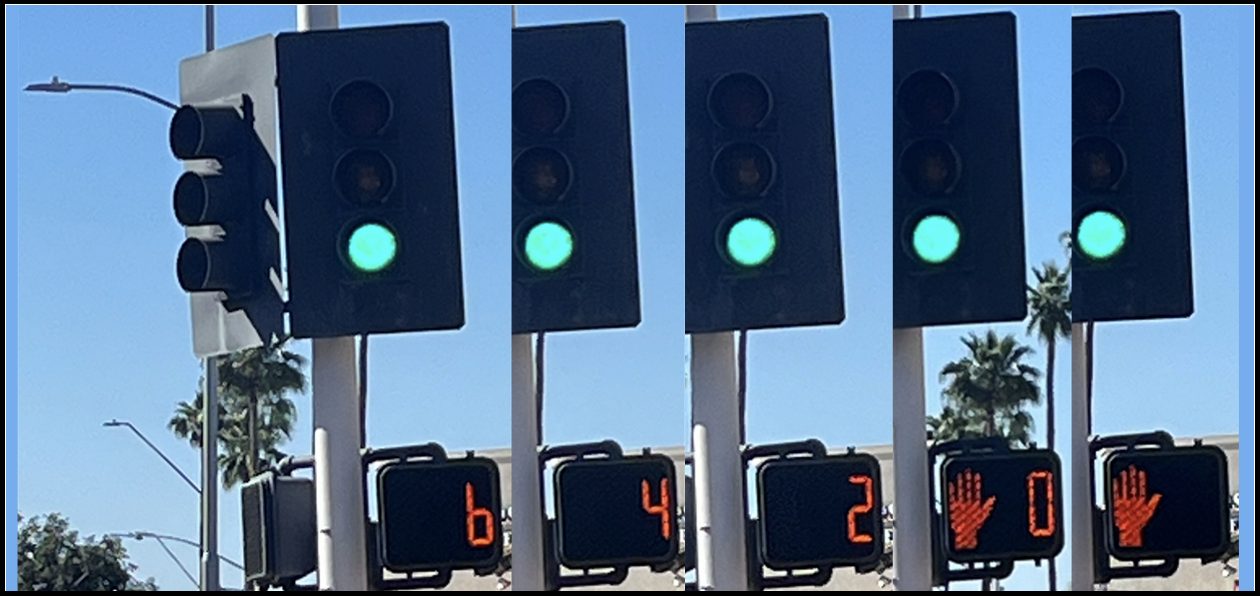
The pedestrian countdown clocks showing the red hand, with or without the zero, with the green circle still appearing, is an easy-to-understand confusion … with a very logical explanation.
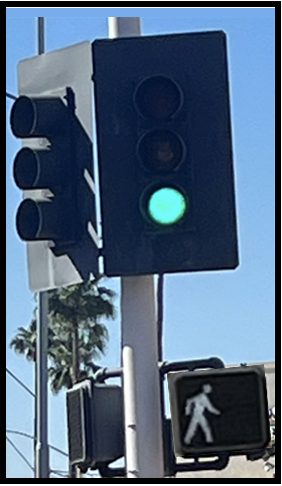
The green circles are for vehicles. The walk signals are for pedestrians. Sometimes they appear simultaneously, sometimes they do not.
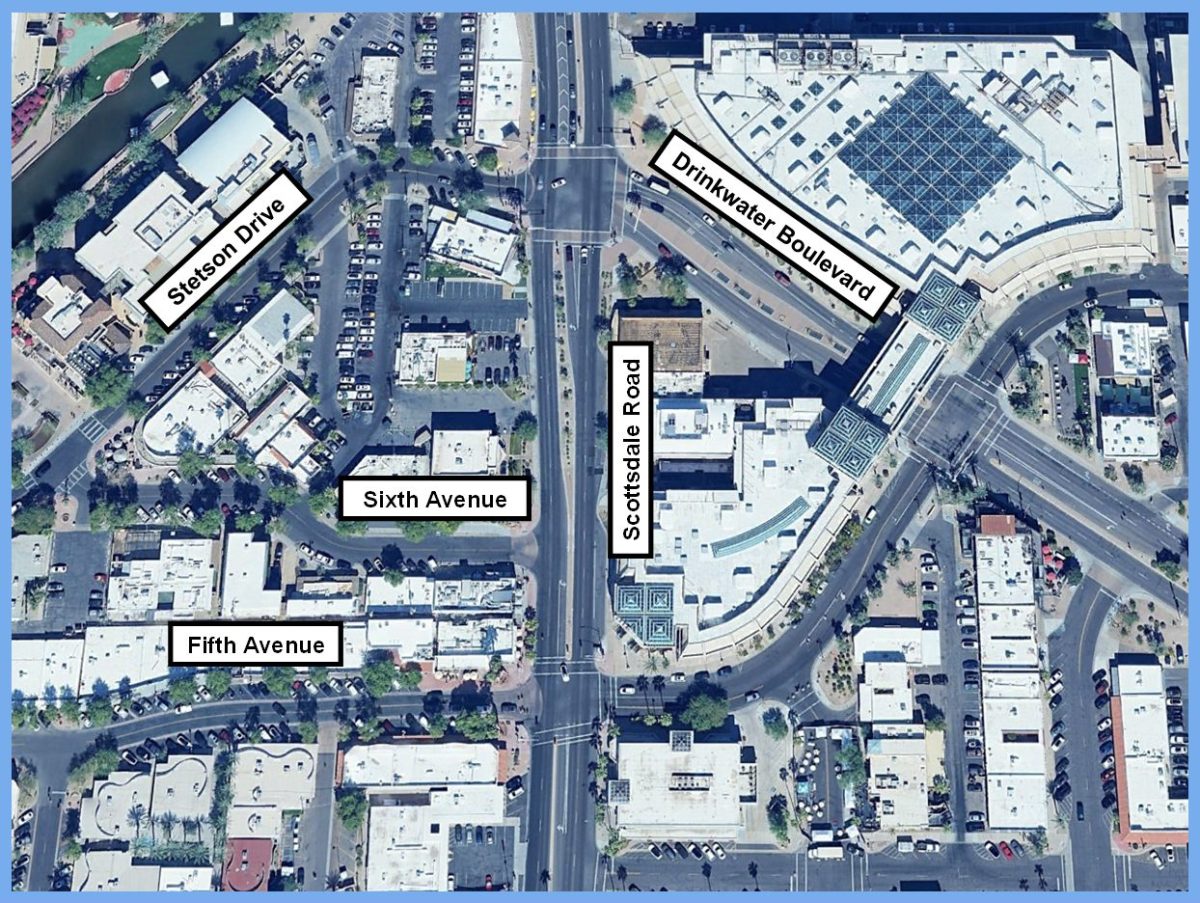
The sequence of photographs above were taken on Scottsdale Road at its intersection with 5th Avenue. 5th Avenue is approximately 36 feet wide. Nationwide, our design speed for pedestrians is 3.5 feet-per-second.
Therefore, for crossing 5th Avenue at Scottsdale Road, the sum of the WALK indication time (the person walking symbol) and the countdown clock time must be 10.3 seconds or longer.
While cars travel faster than people walk, there are many more cars traveling on Scottsdale Road than people walking on the adjacent sidewalk. So many cars that they need much more time than 10.3 seconds to cross 5th Avenue. A car on Scottsdale Road traveling at 25 mph would only need 2.1 seconds to cross 5th Avenue. However, typically, there are 90 seconds of continuous vehicles traveling north and south on Scottsdale Road.
So, the green circle for Scottdale Road vehicles needs to be 90 seconds, while the pedestrian walking person symbol plus the countdown clock only needs to be 10.3 seconds.
Almost always, there are many vehicles approaching a traffic signal, more than were waiting for the red circle to become a green circle. We’ve all had the unpleasantry of approaching a green light that becomes a yellow light before we arrive, forcing us to stop on the red light and become one of the vehicles waiting for the next green light. Also, typically vehicles are still moving when the green light changes to yellow, then to red.
The actual time available for a person to walk across 5th Avenue at Scottsdale Road is 27 seconds: 10 seconds of the walking person symbol followed by 17 seconds of the countdown clock. Pedestrians have more than sufficient time to cross 5th Avenue.
Whenever possible, traffic engineers prefer to have the walking person symbol appear for the entire time necessary to cross the street. The countdown clock is extra time to allow for slower walking people and people who arrive after the walking person first appears.
Traffic signal timing is a balance between conflicting traffic. Traffic engineers ensure that everybody gets an opportunity to travel through an intersection, and we try desperately hard to prevent anybody from waiting too long.
The green circle and the pedestrian red hand often appear simultaneously. This occurs when there are more vehicles needing a longer green light than the time necessary for a pedestrian to cross the street.
Traffic signals are timed to give most vehicles and pedestrians green lights as long as possible and red lights as short as possible. Quite the challenge, as a green light for some people is by definition a red light for other people. The very purpose of a traffic signal is to stop some people so other people can go.
Typically, pedestrians see a walking person followed by a countdown clock for more than enough time to cross a street, though there is a limit. We’ve all had the experience when a red light is too long. If we kept the pedestrian walking person symbol on when no pedestrians are present, this would result in vehicles also having a red light that was too long. We also cannot abruptly stop the walking person symbol or the countdown clock – we need to provide enough time for a person in the street to finish crossing before the vehicles on the intersecting street have a green circle.
Back to our design walking speed of 3.5 feet-per-second, which is 5 mph. Generally, pedestrians walk at 3.6 to 5.4 feet-per-second (5 to 8 mph). The speed traffic engineers use to time pedestrian signals is essentially a slow walk. However, manually operated wheelchairs typically travel at 2.7 feet-per-second. So, our design walking speed does not accommodate manually operated wheelchairs. Though electric wheelchairs typically travel at 4.1 feet-per-second, so our crossing time is longer than necessary for electric wheelchairs.
For comparison purposes, a moving walkway at airports is typically 2.5 feet-per-second.
Once upon a time, before the countdown clock was invented, there was a flashing DON’T WALK signal. Many locations throughout the country and Valley still use this pedestrian indication. Studies have measured walking speeds with this flashing DON’T WALK signal versus walking speeds with the new countdown clock. Wait like you’re at a red light for several seconds before you read the next sentence, so you can guess which device created the slower walking speed.
The walking speeds were slower with the countdown clock. Evidently, we hurry with the uncertainty of when the flashing DON’T WALK signal will end. We walk more leisurely when we have certainty of when the pedestrian signal becomes a red hand.
Traffic engineers recognize that pedestrians are the most vulnerable mode of travel. Moving vehicles present pedestrians with the greatest danger. We therefore protect pedestrians by providing very clear indications as to when vehicles should be stopped so pedestrians can walk reasonably safely. We also provide clear indication of when vehicles will be moving so that pedestrians do not walk. We’re all sharing the same planet, we’ll each get our turn to cross a street. Please be attentive to the signal for you: overhead traffic signals when you’re in a vehicle, pedestrian signals when you’re walking. While you’re waiting for a green circle or for a walking person symbol, say something nice to the person you’re with.