(Disclosure: Summit Land Management is a Rose Law Group-related company and contracted with the firm.)
By Paul Basha, Kayla Amado of Summit Land Management
How do traffic engineers determine the number of traffic lanes and whether there should be one or two left-turn lanes and whether or not right-turn lanes should exist?
Number of cars and trucks. Generally, one through lane on a typical street can accommodate 8,000 daily vehicles. If a street has more than 8,000 daily vehicles in one direction, it should have two lanes in that direction. More than 16,000 daily vehicles; then three lanes.
So, we count the number of cars on a specific street or predict the number of cars that will be on a particular street. Then, we provide the correct number of through lanes. The table below is adapted from the Maricopa County Department of Transportation Roadway Design Manual.
CLASSIFICATION THROUGH LANES MEDIAN DAILY VOLUME
Parkway…………………………… 6 …………………..Raised……….. 40,000 to 85,000
Major Arterial…………………….. 6 …………………..Raised……….. 25,000 to 55,000
Minor Arterial…………………….. 4 …………………..Raised……….. 15,000 to 35,000
Major Collector ………………….. 4 ……………….. Turn Lane …….. 10,000 to 30,000
Minor Collector ………………….. 2 ……………….. Turn Lane …….. 5,000 to 15,000
A Parkway is a high-volume restricted-access type of street that is beginning to appear in metropolitan Phoenix. It is a hybrid of a freeway and a large city street. The best example is the current construction of the Sonoran Desert Parkway in the City of Maricopa, about 3 miles south of the commercial core of Maricopa, at the entrance to the Ak-Chin Hotel and Casino of television advertisement fame. When complete, the Sonoran Desert Parkway will connect SR-347 (Maricopa Road or John Wayne Parkway) to I-10, a 16-mile roadway. This will be a critically beneficial connection between Maricopa and Phoenix, creating huge development potential in Maricopa and adjacent Pinal County.
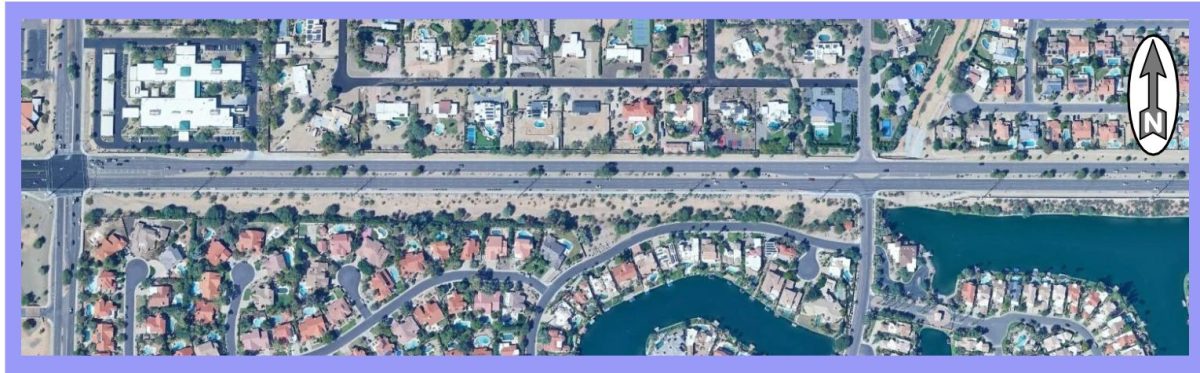
The reason for the range in the daily volume for each of the street classifications is the degree of access restriction. The fewer the driveways, intersecting streets, and traffic signals: the higher the traffic volume. The aerial photograph below shows slightly more than one-half mile of Shea Boulevard with intersections at only one-half-mile intervals. This roadway segment can carry congestion-free traffic volumes near the high end of the major arterial range.
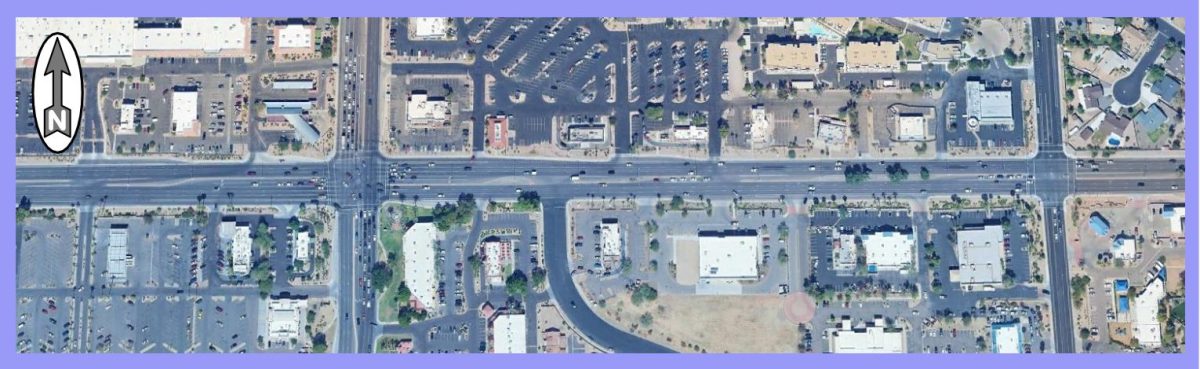
The aerial photograph below shows more than one-half mile of Baseline Road with numerous driveways and median openings. Because of the resulting congestion, this roadway segment can only carry traffic volumes near the low end of the major arterial range.
There’s always a conflict between people trying to quickly drive long distances and adjacent property owners who want shoppers to turn into and out of their businesses.
Traffic is one of those odd parts of the human existence where what is good for the individual is often bad for the rest of us. Great for you if you need to slow down to focus on your map app so you can turn right at the proper street, though bad for the dozen people behind you who know exactly where they need to turn and it is another mile or two down the road, and they’re late for an important event.
Great bumper sticker, “when I get old, I will move north and drive really slow”.
Right-turn lanes help to solve that problem. The slowly-moving right-turn people get out of the way of the people driving straight in a hurry.
As you would guess, traffic engineers install right-turn lanes when there are many vehicles turning right and many cars going straight. Different agencies have different combinations of right-turn traffic volume and straight traffic volume to require right-turn lanes on different street classifications. The more straight vehicles, the fewer the right-turning vehicles necessary to require a right-turn lane. The decision also considers the posted speed limit and the number of through lanes. High speed limit, lower the necessary right-turning vehicles. More lanes, higher the necessary right-turn volume requiring a right-turn lane.
While similar volume requirements exist for determining when two left-turn lanes are required, typically that decision is made with a much more thorough analysis. The simple requirement is if more than 300 hourly vehicles turn left, two left-turn lanes are needed.
The more complex and more accurate methodology for determining the number of through lanes, right-turn lanes, and left-turn lanes is a level-of-service analysis.
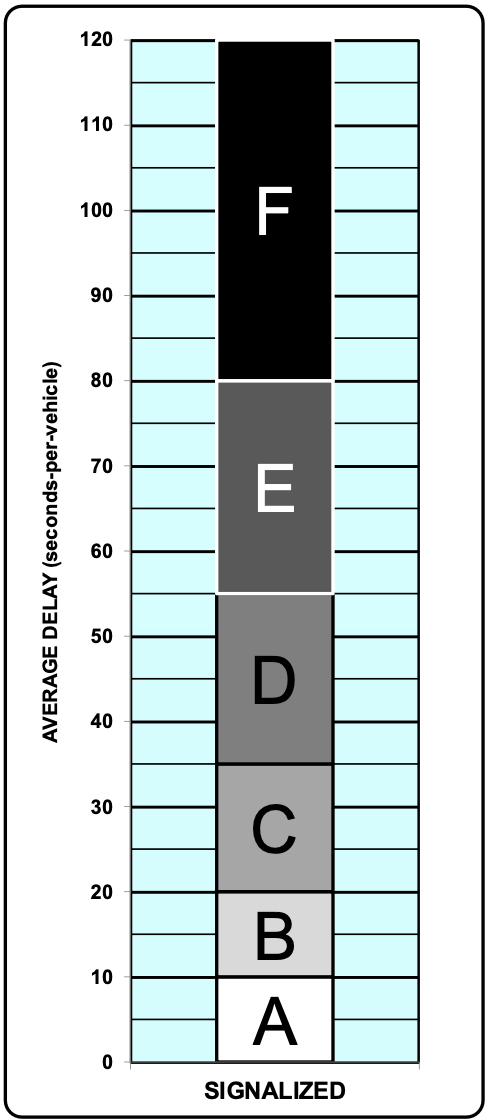
Level-of-service is a ranking system for transportation facilities. “A” has the least congestion, and “F” has the most congestion.
For intersections, the level-of-service is determined by average delay. This can be directly measured, though almost always, traffic engineers use software that estimates average delay considering traffic volume, lane number, and traffic signal operation among other factors.
These rankings are not like school grades. At intersections, “A” and “B” reveal that we are devoting too much money and land for too few vehicles. “E” and “F” mean that we have too many vehicles for the available lanes. “C” and “D” are the goldilocks levels-of-service, all is well.
Separate levels-of-service are determined for each lane, each approach, and the entire intersection. If a single left-turn lane has average delay high enough to be an “E” or “F”, there should be a second left-turn lane. If necessary and feasible, a third left-turn lane could be provided.
In metropolitan Phoenix, only two large intersections have three left-turn lanes: Shea Boulevard at SR-51 and SR-303 at Grand Avenue. The Shea / SR-51 interchange is about 9 acres, not easy to purchase that much very-high-value commercial property near high-volume streets.
For the most recent expansion of Scottsdale Fashion Square, the City of Scottsdale required the developer to widen Highland Avenue, between Fashion Square and Optima, at Scottsdale Road, to accommodate three eastbound-to-northbound left-turn lanes. Three left-turn lanes would allow that green left-turn arrow to be shorter, giving Scottsdale Road traffic longer green lights.
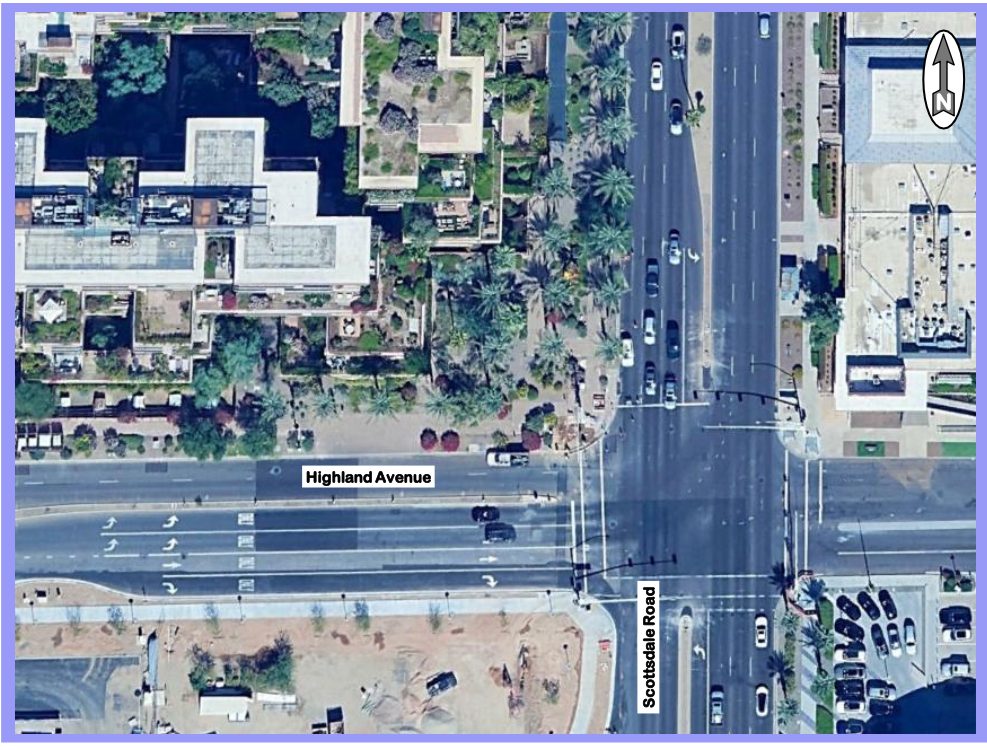
Would be a good thing. Though it is doubtful that drivers would stay in their lane as they turned left. (Why is it so easy for people in other states to stay in their lane, though almost impossible for Arizona drivers to turn into the lawfully correct lane while staying between the lane lines?) So, it has not yet been striped as three left-turn lanes. So, both Scottsdale Road drivers and Highland Avenue drivers have longer red lights.
Oh, notice there is only a pedestrian crosswalk on the south side of Highland Avenue. The north side has no crosswalk. This makes it easier for the large number of eastbound-to-northbound left-turning cars, and to keep pedestrians safe by walking on the south side of Highland Avenue. Pedestrians here almost always stay between the crosswalk lines.
Curious about something traffic? Call or e-mail Paul at (480) 505-3931 and pbasha@summitlandmgmt.com.