The Federal Reserve did what almost everyone expected on Wednesday and left its benchmark interest rate unchanged at a range of 3.50% to 3.75%, the fifth straight meeting without a move. The news was not the decision, it was the split behind it. Three officials dissented in favor of raising rates by a quarter point, the most dissents at a single meeting in about a decade.
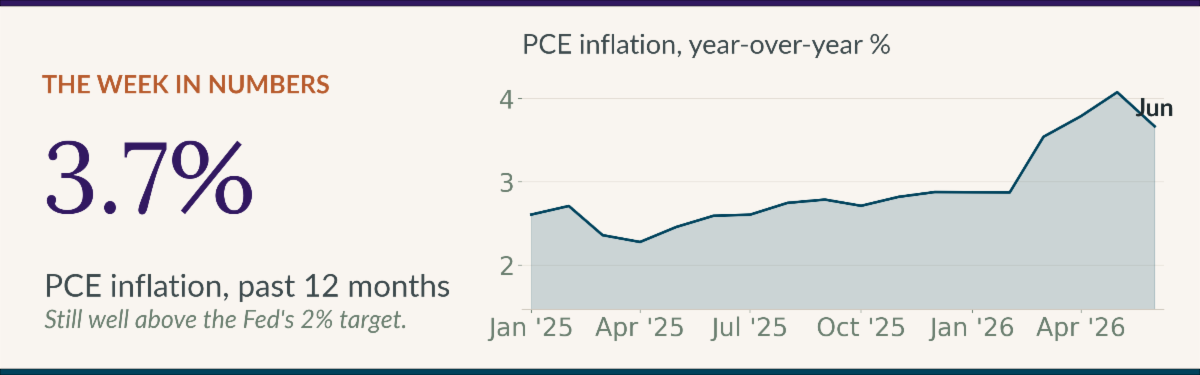
The disagreement is easy to understand once you look at prices. Inflation simply will not come down to where the Fed wants it. The Fed’s preferred gauge, the personal consumption expenditures (PCE) price index, was up 3.7% over the past year in June, and the core version that strips out volatile food and energy was up 3.3%. Both eased a touch from May, helped by a pullback in energy prices, but both remain well above the Fed’s 2% target. The dissenters worry that the recent run back up in oil prices will undo even that modest June progress. The doves would rather wait and see.
Real gross domestic product (the value of everything the economy produces, adjusted for inflation) grew at a 1.5% annual rate in the second quarter, down from 2.1% in the first. On its face that looks soft. But strip out the volatile swings in trade and inventories and the picture is firmer. Real final sales to private domestic purchasers, a cleaner read on underlying demand, rose a solid 3.9%. In other words, the economy is not stalling. It is growing at a decent clip while prices keep climbing. The GDP report’s own price measure jumped at a 5.7% annual rate, up from 3.6% the quarter before, a reminder that inflation actually sped up in the spring.
The job market, meanwhile, is still tight. Initial claims for unemployment insurance were just 197,000 in the last week of July, near their historic lows. And the Employment Cost Index, the Fed’s broadest measure of what employers pay in wages and benefits, rose 0.9% in the quarter and 3.4% over the year. That is roughly the slowest annual pace since 2021, so wage pressure is easing, but it is still running ahead of the 2.5% or so that the Fed associates with 2% inflation. That gap, in a sentence, is the whole argument inside the committee.
So the Fed is stuck in an uncomfortable spot. Growth is potentially soft enough that a rate hike could tip the economy into a stumble, and inflation is hot enough that a rate cut would look premature. Warsh has done away with formal forward guidance, which means every meeting is now genuinely live and the press conference matters more than the statement. For now, the answer is to hold and wait. The September meeting is shaping up as the real decision point, and with oil prices climbing again, the market has started to bet on a rate hike.
U.S. Snapshot
Real GDP grew at a 1.5% annual rate in the second quarter, down from 2.1% in the first, though underlying demand held up better: real final sales to private domestic purchasers rose 3.9%.
The PCE price index, the Fed’s preferred inflation gauge, was up 3.7% over the year in June (core 3.3%), easing from May’s 4.1% as energy prices fell 0.1% on the month. Personal income rose 0.2% and consumer spending 0.3%, leaving the saving rate at 2.7%.
Initial jobless claims were 197,000 for the week ended July 25, up 9,000 but still near historic lows. The four-week average was 202,750.
The Employment Cost Index rose 0.9% in the second quarter and 3.4% over the year, roughly the slowest annual pace since 2021 but still above pre-pandemic norms.
Durable goods orders rose just 0.3% in June, well short of the 1.7% expected. Excluding transportation, orders were up 0.6%, led by computers and electronics.
The Conference Board’s Consumer Confidence Index slipped to 90.8 in July from 92.2 in June, below the 92.4 that forecasters expected. The University of Michigan’s final sentiment reading, by contrast, rose to 55.2, its best since February, helped by lower gasoline prices.
Home prices rose just 1.11% over the year in May (S&P Cotality Case-Shiller national index), trailing inflation for a 12th straight month. Nationally, the homeownership rate held at 65.0% in the second quarter.
Arizona Snapshot
Arizona’s homeownership rate climbed to 68.8% in the second quarter from 67.4% in the first, according to the Census Bureau’s Housing Vacancy Survey. Even so, it sits well below the 72.3% of a year ago, part of a broad national drift lower in ownership as high prices and mortgage rates keep would-be buyers renting.
Greater Phoenix eased to 66.4%, down from 67.2% in the first quarter and from 71.8% a year earlier.
Greater Tucson registered 68.0%, up sharply from 59.2% the prior quarter, though these metro readings come from a small sample and swing widely from quarter to quarter. Tucson too remains below its 72.0% of a year ago.