(Disclosure: Summit Land Management is a Rose Law Group-related company and contracted with the firm.)
By Traffic Engineer Paul Basha, Kayla Amado | Summit Land Management
Thank you for your article on pedestrian countdown clocks. Very helpful understanding things I see every day that I did not understand before. That led me to related questions. What is the purpose of the push button? Does it make the walk signal appear sooner? Does pushing it many times make the walk signal appear sooner? Why are there sometimes push buttons and sometimes not?
Great questions.
The push buttons simply inform the traffic signal that a person is there who wants to cross the street safely on a walk signal. The signal will provide the walk symbol at the next appropriate time. Most every signal is controlled by a traffic signal timing plan. The traffic signal timing plan simply organizes the green lights to provide the longest consecutive green lights at a group of signals for the most traffic. It’s simply a highly sophisticated automatic alarm clock.
Signals know when vehicles are present through one of two devices, a wire or a camera. The process utilized for decades in greater Phoenix has been a wire embedded in the pavement. The aerial photograph below indicates the wire rectangle, with a close-up inset in a purple rectangle.
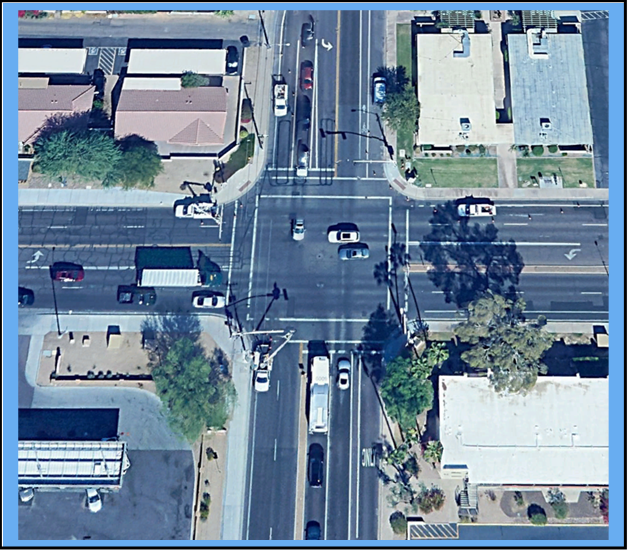
The wire is typically only a rectangle, though sometimes, it also has an extra line in the middle. The extra line assists the device to detect motorcycles and bicycles.
The detector is not a pressure pad or a metal detector. Electrical current through the wire creates a magnetic field in the air above the pavement. A vehicle, or any large object, interrupts the magnetic field which informs the signal of a vehicle presence.
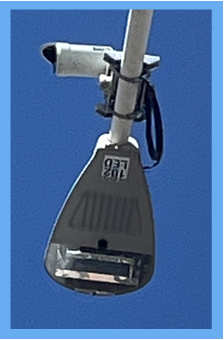
Increasingly, cities throughout metropolitan Phoenix are using cameras, shown in the photograph to the right. The cameras are mounted on the light pole, often attached to the traffic signal pole, though sometimes on a separate pole.
Either device merely informs the traffic signal that a vehicle is present. Sometimes the devices are also used to determine the number of vehicles present. When Phoenix first started requiring three vehicles to be present for agreen left-turn arrow to appear, in the late 1980’s, they also installed the wires in two places, with a space for another vehicle in-between. This ensured that there would be at least three vehicles waiting to turn left before the left-turn arrow would appear.
Some Valley cities are experimenting with cameras that can detect pedestrians waiting to cross a street. The trick is the system knowing which direction the person(s) wants to cross the street. The camera providers tell us that the artificial intelligence within the system can determine which street the pedestrian wants to cross. Sometimes it is obvious by where the person is standing or facing, sometimes the person(s) is too subtle with their intentions. Sometimes the person(s) is ambivalent – when they want to cross both streets, they cross whichever street first provides the walk symbol.
To another of your questions. No, pushing the pedestrian push button does not make the walk symbol appear sooner. And no, the push button also does not count the number of times the button is pushed. It is merely an on or off switch, like a light switch in a building. Also, a pedestrian push button does not appreciate or operate better when hit viciously or repeatedly.
Pedestrians walk slower than cars move, 5 to 8 mph compared to 25 to 45 mph on city streets. When the pedestrian push button is activated, the signal knows to provide the walk symbol plus the countdown clock with sufficient time for a walking pedestrian to cross the street. If the push button is not pushed, the signal will only provide sufficient time for a vehicle to drive across the street, not enough time for a pedestrian to cross the street.
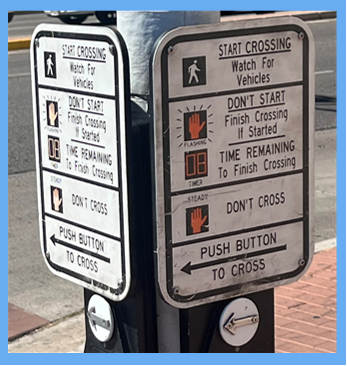
Sometimes there is only a pedestrian push button for one street, and there is not a push button for the other street. If a street has large numbers of vehicles, the push button is not installed. In those circumstances, the green light time for vehicles is so long that there is also time for a pedestrian to cross the street.
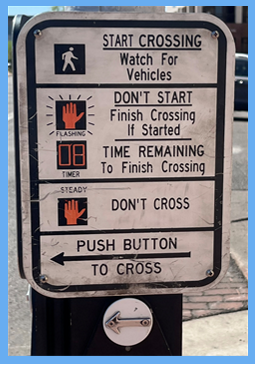
Sometimes, there are pedestrian push buttons for each street. The arrow at the bottom of the sign points in the walking direction. Please only push the button for the direction(s) you wish to travel. Otherwise, the walk signal appears and vehicles have to wait for phantom pedestrians, causing unnecessary congestion.
Oh, if the button is there, you need to push it (firmly, gently, only once), if you would like to cross the street safely with a walk signal and a countdown clock or flashing don’t walk signal. Otherwise, if a pedestrian push button is present and you do not push it, the walk symbol will typically not automatically appear.
Curious about something traffic? Call or e-mail Paul at (480) 505-3931 and pbasha@summitlandmgmt.com.